


Honeywell Requests Input for Development of Android Mobile Computers
 Honeywell Scanning & Mobility recently announced the launch of its Honeywell Developer Program to give independent software vendors (ISVs) and end-users a voice in the development of Honeywell mobile computing products that will utilize the Android operating system. Through the program, participants will also have the opportunity to develop and test Android-specific applications on Honeywell’s newest mobile computer, prior to launch.
LXE is now part of Honeywell
Acquisition is the third major auto-identification and data collection company to become part of Honeywell.
Honeywell announced that it has completed its acquisition of EMS Technologies, Inc., parent company of LXE.
EMS is a leading provider of connectivity solutions for mobile networking and rugged mobile computers.
The acquisition will enhance Honeywell’s existing capabilities in rugged mobile computing technologies. EMS’s Global Resource Management (GRM) division provides highly ruggedized mobile computing products and services for use in transportation, logistics, and workforce management settings as well as secure satellite-based asset tracking and messaging technology for search and rescue, warehousing, and field force automation environments.
“Acquiring EMS Technologies demonstrates our commitment to build on our leadership position in the global barcode scanning and mobility industry,†said Darius Adamczyk, president of Honeywell Scanning & Mobility. “By adding EMS Technologies to our business, we will acquire complementary rugged hand-held and vehicle-based products and expand our presence in warehousing, manufacturing and port segments. These new products and segments will be growth drivers for our business.â€
Honeywell Scanning & Mobility was formed in 2008, following Honeywell’s acquisition of two leading manufacturers of automatic identification and data collection (AIDC) solutions, Handheld Products and Metrologic Instruments.
Honeywell to Buy Parent Company of LXE
Honeywell today announced that it has signed a definitive agreement to acquire EMS Technologies, parent company of LXE, a leading provider of rugged mobile computers.
“EMS is a terrific addition to Honeywell, adding leading positions in attractive markets that are closely aligned with favorable trends in the growing Command, Control, Communications, Computers, Intelligence, Surveillance, and Reconnaissance (C4ISR) space and commercial aerospace, as well as being highly complementary to our existing Scanning and Mobility business,” said Honeywell Chairman and Chief Executive Officer Dave Cote. “Honeywell is uniquely positioned to acquire EMS due to the strategic fit across EMS’s Global Resource Management and Aviation divisions. The acquisition brings engineering expertise, differentiated technologies, global reach, and profitable adjacent segments that build upon our great positions in good industries and enhance our growth profile.”
EMS’s GRM division offers a broad range of solutions for supply chain logistics, mobile workforce management, and remote asset monitoring applications, supported by hundreds of partners worldwide. EMS’s proven mobile resource management solutions include LXE-branded rugged handheld and vehicle-mounted computers featuring multiple radio technologies and satellite-based global tracking and monitoring solutions for cargo, fleet assets, and personnel.
“This is another terrific transaction for our Scanning and Mobility business,” said Honeywell Automation and Control Solutions President and Chief Executive Officer Roger Fradin. “EMS strengthens our core mobile computing business and expands our addressable market with complementary new products, channel partners, and entry into the warehousing and port segments that we believe will be growth drivers for the business., This also represents an opportunity to demonstrate our proven acquisition integration process.”
Man Who Popularized UPC Barcode Passes Away at 81
Alan Haberman did not invent the universal product code (AKA UPC) barcode, but he is largely responsible for its selection over competing product marking standards decades ago.
His death, in Newton, Mass., was of complications of heart and lung disease, his family said.
Mr. Haberman led the industry committee that chose the bar code over other contenders — circles, bull’s-eyes and seemingly random agglomerations of dots — in 1973.
By all accounts, he spent years cajoling manufacturers, retailers and the public to accept the strange new symbol.
Source: Alan Haberman, Who Ushered In the Bar Code, Dies at 81
Psion-Teklogix now “Psion”
Teklogix is removed from the company name. New identity better reflects the company strategy.
Psion has shortened its operating company name, removing the name “Teklogix†to create a more effective global brand. Psion’s corporate identity has also been refreshed to work better in the digital world. These developments mark the next significant stage in the company’s transformation and accurately reflect the group’s business strategy.
“Our research showed that we had to remove the word “Teklogix” from our name, to unite the business around one, clear, global identity,†said John Conoley, CEO of Psion. “We found that the complexity of the dual company name was impacting our business by confusing our customers, resellers and other key stakeholders, especially in new markets for Psion. We also took the opportunity to refresh the brand to make it properly mirror our business strategy and to work better in the digital world.â€
Barcode Keyboard for Android Lets You Scan Wherever You Can Type
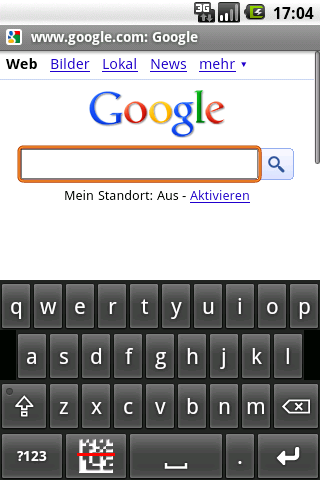
Barcode Keyboard app from TEC-IT replaces the standard on-screen keyboard on your Android device with one that includes a barcode key. Clicking the barcode key uses your phone’s camera to make snap a picture of a barcode and then automatically enters the decoded contents of the barcode wherever the cursor is located.
The Barcode Keyboard software also supports advanced setting like data prefixes and suffixes (characters that are automatically entered before or after the scanned barcode).
This software helps convert your Android phone into a very basic barcode scanner.
Honeywell And Zebra Technologies Ally To Deliver Seamless Mobile Computing, Barcode Scanning And Printing Solutions
Relationship brings advanced automatic identification solutions to serve customers in healthcare, self-service and field mobility segments
Honeywell and Zebra Technologies, a global leader in label printing and automatic identification solutions, announced the formation of an alliance to market and sell advanced automatic identification solutions. The agreement enables both companies to deliver cutting-edge mobile computing, scanning and printing solutions for the healthcare, self-service and field mobility industries.
“Zebra’s strong brand recognition throughout the AIDC marketplace and its position as a global market leader make it a perfect strategic partner as we build out our product offerings,” said John Waldron, vice president of worldwide marketing, Honeywell Scanning & Mobility. “After integrating both Hand Held Products and Metrologic, we have turned our sights to building a global champion. An important part of this growth lies in working with world-class industry players like Zebra.”
Microscan demonstrates the latest 2D barcode imagers for Direct Part Mark reading at Shanghai Automotive Components Show

Microscan has announced successful results from the recent Automotive Components Shanghai show. During the show, Microscan demonstrated their diverse line of barcode and machine vision products for automotive parts traceability and error proofing processes, including the latest 2D barcode imagers optimized for reading direct part marks.
The Automotive Components exhibition featured suppliers of products such as engine parts, electrical equipment, fuel systems, cooling systems, engine-driven compressors, fans, air conditioners, suspension members, tires, and chassis. At the exhibition, Microscan demonstrated their barcode scanners and 2D barcode imagers, machine vision software, smart cameras, and machine vision lighting.
Local interest in Microscan’s product line was very strong, especially among suppliers recognizing the growing demand for barcode traceability of automotive parts. Of particular interest were Microscan’s QX Hawk and Mobile Hawk imagers, which are optimized to read challenging 2D direct part marks such as Data Matrix. Permanently marked Data Matrix codes are becoming more commonplace to identify and trace components used in automotive and aerospace manufacturing.
Professional Canon Camera Now Supports Barcode Readers
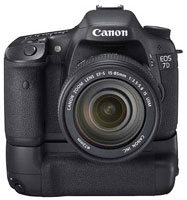 Canon is now shipping a special EOS 7D kit that includes support for barcode scanners and has the ability to embed barcode data directly into the picture’s metadata.
Invisible Barcodes for Security and Inventory Management Applications
Kodak is introducing a new virtually invisible clear ink. KODAK NEXPRESS Red Fluorescing Dry Ink is clear to the naked eye, but becomes red fluorescing when illuminated with an appropriate ultraviolet (UV) light source. The ink can be used to print unobtrusive images and non-reproducible bar codes on various printed materials, which then can be read with specialized bar code readers. The NEXPRESS Red Fluorescing Dry Ink enables a wide range of security and inventory management applications, including certified documents, such as medical prescription pads, drivers’ licenses and event tickets.
“This innovative expansion of the NEXPRESS Fifth Imaging Unit Solutions allows digital print service providers to enter the lucrative and growing secure documents and ‘track and trace’ markets,†said Steve Fletcher, General Manager, Electrophotographic Printing Solutions, Vice President, Kodak. “The amazing versatility of the family of KODAK NEXPRESS Digital Production Color Presses is designed to help print service providers stay on the forefront of a demanding, quickly changing marketplace.â€