


SATO Corporation Celebrates 70th Anniversary
SATO Corporation, a pioneer in the Automatic Identification and Data Collection (AIDC) industry and a leader in barcode printing, labeling, and EPC/RFID solutions, celebrates its 70th Anniversary in 2010.
SATO Corporation, with headquarters in Japan, was established in 1940 to manufacture and sell packaging machinery. In 1962, SATO was a pioneer in introducing one of the first hand-held labelers and established operations as an international supplier of labeling machinery. The U.S. subsidiary was established in 1977 and eventually became SATO America, Inc. in 1987. During that period, SATO developed the world’s first thermal transfer barcode printers for JAN/UPC/EAN POS systems and became the leader in applying the technology to the market.
SATO has remained at the forefront of thermal printing technologies. Our product line includes direct thermal and thermal transfer printers, OEM print engines, printer accessories, label design software, labels and thermal transfer ribbons. Today, SATO continues its tradition of designing and manufacturing high quality printers for a wide variety of industries and applications that deliver reliable and dependable performance with every print job.
Celebrating the World’s One Millionth Magellan Bi-Optic Scanner

After sixteen years of designing and manufacturing the world’s best selling bi-optic scanner, Datalogic Scanning proudly celebrated the completed production of its one millionth Magellan bi-optic scanner on April 30th, 2010. As the scanner rolled off the production line at Datalogic’s headquarters in Eugene, Oregon, USA, it greeted a crowd of elated employees who understood what this milestone means for not only Datalogic, but for its customers and the AIDC industry as a whole.
In 1994, the world was introduced to the first Magellan bi-optic scanner, named after the explorer whose expedition was the first to circle the globe, Ferdinand Magellan. The Magellan scanner was the industry’s first scanner with 360-degree scanning technology, setting the stage for remarkable POS innovation across the retail supermarket segment.
Barcode ID’s Criminal
Barcoding and crimefighting seem to go hand in hand. We’ve already seen how a handheld barcode scanner was used to fight off a convenience store robber.
Now comes a story from the UK how a burglar was traced by the barcode label that fell off his chisel.
Thief Roy Watson nearly made a perfect getaway after smashing through the wall of an electrical store to steal £33,000.
But the 38-year-old left behind a barcode from a chisel he used during the break-in.
The inch-long scrap of paper was traced to a Wickes DIY store. Officers trawled CCTV footage and saw Watson buying the tool hours before the burglary.
The crook admitted the crime and has been jailed for two and a half years.
Source: Barcode foils burglar: Thief traced after label fell off his chisel
Brave Handheld Barcode Scanner [in Hands of Elderly Woman] Fights off Robber
A dynamic duo of a handheld barcode scanner and a feisty elderly woman attempted to intervene in the robbery of a convenience store in Malden, Massachusetts.
A security camera recording captured the entire event.
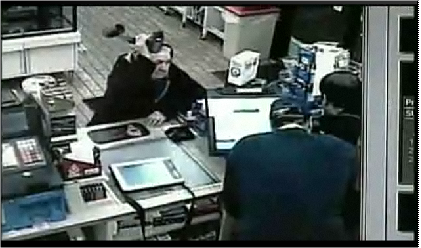
We agree with the police that attacking a robber is “not something we would recommend for anybody to do”. If you do choose to do so, swing the base of the barcode scanner stand (that’s where all the weight is)
Barcodes Key to Money-saving Idea for VA Hospitals
Nancy Fichtner, an employee of the Department of Veterans Affairs has won the first ever President’s SAVE Award. The SAVE Award is given to the Federal employeee with the best idea to save taxpayer dollars and make the government perform more effectively and efficiently.
Fichtner’s idea is to add a barcode to medicines that would allow a hospital patient to take the unused portions of medications such as ointments, inhalers, eye drops, and other bulk items home with them after discharge. These medicines are now being thrown away in many parts of the VA system because they lack adequate labeling for in-hospital and at-home use.
Fichtner’s idea was selected amongst over 30,000 entries. On Monday, December 21, Nancy will present her idea to President Obama at the White House.
Scanning Students

Â
Imagine a checkout line at your local grocery store, but with students lining up to be scanned instead of your groceries. That is the growing scene at college fairs across the country since the National Association for College Admission Counseling introduced barcode scanners at several of its National College Fairs.
The technology allows applicants to fill out their contact information online and can then print out their own personal barcode to take to the fair. In turn, colleges attending the fair can rent scanners, allowing students to swipe their barcodes at the colleges they are interested in. Universities can download an applicant’s information on the computer within 24 hours after the fair.
Barcodes Threat to Secret Ballot, Lawsuit Alleges
A lawsuit filed in the state Supreme Court is aimed at blocking the use of bar codes on election ballots in Washington because they could be used to identify a voter’s choices.
The lawsuit alleges that more than 1 million Washington voters could have their secret vote preferences violated in counties that use certain ballot-tracking equipment. Elections officials say the claim is not true.
“In addition to violating statutory ballot secrecy standards, the use of ballot IDs threatens actual compromise of ballot secrecy,†declares the suit prepared by Knoll Lowney, an attorney who has filed suits in the past against targets such as Tim Eyman’s initiatives, U.S. Senate candidate Mike McGavick and the Building Industry Association of Washington.
Lowney estimated that one-third of eligible voters are affected in Washington, but Reed’s elections chief denied that there is any risk.
Barcoding Poultry

A team of Irish scientists has devised a method of identifying individual chickens by putting miniature barcodes on their beaks and legs, and older hens by their combs. Working at the UCD Bioresources Research Centre, the researchers achieved a 97 percent accuracy rate in experiments on identifying individual bird parts with barcodes.
Led by Professor Shane Ward, the group set out to find novel, accurate, tamper-proof and cost-effective systems to track and trace animals using among other things, biometric identification. While laying hens do not have fingerprints, they discovered they have individual comb profiles. The researchers developed specific biometric algorithms to isolate the comb profiles using mathematical modeling techniques.
DataBars on Produce

Look closely at recent supermarket coupons, and you may see some new markings on them near the traditional bar code: sets of neat black bars stacked in two rows. These new symbols are called GS1 DataBars and can store more data than traditional bar codes, promising new ways for stores to monitor inventory and for customers to save money.
One use of the symbols will be in sophisticated coupon offers that combine deals on multiple products. A single coupon, for example, could offer discounts on three separate items like eggs, bacon and biscuits, all in one transaction. Another use of the new symbols is already helping to streamline operations for a common speed bump in the checkout process: loose produce, and it also prevents another checkout problem: cashiers mistaking organic vegetables for less expensive, conventionally grown ones, and ringing them up for the lower price.
In the future, coupon bar codes will probably be read less from strips of paper, and more from cellphones that people hold out for scanning by the cashier.
Continue reading: The Bar Code Is Taking a Leap Forward
Barcodes Could Reveal Your Food’s Credentials
![BarcodeFood[1]](https://www.barcodesinc.com/news/wp-content/uploads/2009/07/BarcodeFood1.jpg) Most manufacturers already use barcodes or RFID chips to track their products. With the help of cheap cellphone and Internet access it is becoming possible to collate data from remote locations around the world and make it available to consumers in grocery stores.
Most manufacturers already use barcodes or RFID chips to track their products. With the help of cheap cellphone and Internet access it is becoming possible to collate data from remote locations around the world and make it available to consumers in grocery stores.
In many cases, are open to the notion that transparency about the source of their food is good for business. The idea is to develop a system to prove to customers that crops are not grown on land recently occupied by tropical rainforest.
In remote regions where farmers don’t have access to computers, they can use cellphones to record the time and place the crop was harvested into an online database. Tracking systems like this should also make it easy to calculate the distance that goods travel to reach stores, allowing consumers to estimate the greenhouse gas emissions racked up by the transport of their food. Heiner Lehr of FoodReg says, “The technology is there. If a big retailer puts itself behind this, it could happen very fast.”
Original article: Barcodes could reveal your food’s credentials