


Honeywell And Zebra Technologies Ally To Deliver Seamless Mobile Computing, Barcode Scanning And Printing Solutions
Relationship brings advanced automatic identification solutions to serve customers in healthcare, self-service and field mobility segments
Honeywell and Zebra Technologies, a global leader in label printing and automatic identification solutions, announced the formation of an alliance to market and sell advanced automatic identification solutions. The agreement enables both companies to deliver cutting-edge mobile computing, scanning and printing solutions for the healthcare, self-service and field mobility industries.
“Zebra’s strong brand recognition throughout the AIDC marketplace and its position as a global market leader make it a perfect strategic partner as we build out our product offerings,” said John Waldron, vice president of worldwide marketing, Honeywell Scanning & Mobility. “After integrating both Hand Held Products and Metrologic, we have turned our sights to building a global champion. An important part of this growth lies in working with world-class industry players like Zebra.”
Microscan demonstrates the latest 2D barcode imagers for Direct Part Mark reading at Shanghai Automotive Components Show

Microscan has announced successful results from the recent Automotive Components Shanghai show. During the show, Microscan demonstrated their diverse line of barcode and machine vision products for automotive parts traceability and error proofing processes, including the latest 2D barcode imagers optimized for reading direct part marks.
The Automotive Components exhibition featured suppliers of products such as engine parts, electrical equipment, fuel systems, cooling systems, engine-driven compressors, fans, air conditioners, suspension members, tires, and chassis. At the exhibition, Microscan demonstrated their barcode scanners and 2D barcode imagers, machine vision software, smart cameras, and machine vision lighting.
Local interest in Microscan’s product line was very strong, especially among suppliers recognizing the growing demand for barcode traceability of automotive parts. Of particular interest were Microscan’s QX Hawk and Mobile Hawk imagers, which are optimized to read challenging 2D direct part marks such as Data Matrix. Permanently marked Data Matrix codes are becoming more commonplace to identify and trace components used in automotive and aerospace manufacturing.
Professional Canon Camera Now Supports Barcode Readers
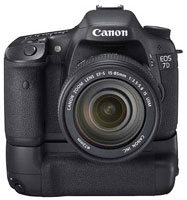 Canon is now shipping a special EOS 7D kit that includes support for barcode scanners and has the ability to embed barcode data directly into the picture’s metadata.
Invisible Barcodes for Security and Inventory Management Applications
Kodak is introducing a new virtually invisible clear ink. KODAK NEXPRESS Red Fluorescing Dry Ink is clear to the naked eye, but becomes red fluorescing when illuminated with an appropriate ultraviolet (UV) light source. The ink can be used to print unobtrusive images and non-reproducible bar codes on various printed materials, which then can be read with specialized bar code readers. The NEXPRESS Red Fluorescing Dry Ink enables a wide range of security and inventory management applications, including certified documents, such as medical prescription pads, drivers’ licenses and event tickets.
“This innovative expansion of the NEXPRESS Fifth Imaging Unit Solutions allows digital print service providers to enter the lucrative and growing secure documents and ‘track and trace’ markets,†said Steve Fletcher, General Manager, Electrophotographic Printing Solutions, Vice President, Kodak. “The amazing versatility of the family of KODAK NEXPRESS Digital Production Color Presses is designed to help print service providers stay on the forefront of a demanding, quickly changing marketplace.â€
SATO Corporation Celebrates 70th Anniversary
SATO Corporation, a pioneer in the Automatic Identification and Data Collection (AIDC) industry and a leader in barcode printing, labeling, and EPC/RFID solutions, celebrates its 70th Anniversary in 2010.
SATO Corporation, with headquarters in Japan, was established in 1940 to manufacture and sell packaging machinery. In 1962, SATO was a pioneer in introducing one of the first hand-held labelers and established operations as an international supplier of labeling machinery. The U.S. subsidiary was established in 1977 and eventually became SATO America, Inc. in 1987. During that period, SATO developed the world’s first thermal transfer barcode printers for JAN/UPC/EAN POS systems and became the leader in applying the technology to the market.
SATO has remained at the forefront of thermal printing technologies. Our product line includes direct thermal and thermal transfer printers, OEM print engines, printer accessories, label design software, labels and thermal transfer ribbons. Today, SATO continues its tradition of designing and manufacturing high quality printers for a wide variety of industries and applications that deliver reliable and dependable performance with every print job.
Celebrating the World’s One Millionth Magellan Bi-Optic Scanner

After sixteen years of designing and manufacturing the world’s best selling bi-optic scanner, Datalogic Scanning proudly celebrated the completed production of its one millionth Magellan bi-optic scanner on April 30th, 2010. As the scanner rolled off the production line at Datalogic’s headquarters in Eugene, Oregon, USA, it greeted a crowd of elated employees who understood what this milestone means for not only Datalogic, but for its customers and the AIDC industry as a whole.
In 1994, the world was introduced to the first Magellan bi-optic scanner, named after the explorer whose expedition was the first to circle the globe, Ferdinand Magellan. The Magellan scanner was the industry’s first scanner with 360-degree scanning technology, setting the stage for remarkable POS innovation across the retail supermarket segment.
Barcode ID’s Criminal
Barcoding and crimefighting seem to go hand in hand. We’ve already seen how a handheld barcode scanner was used to fight off a convenience store robber.
Now comes a story from the UK how a burglar was traced by the barcode label that fell off his chisel.
Thief Roy Watson nearly made a perfect getaway after smashing through the wall of an electrical store to steal £33,000.
But the 38-year-old left behind a barcode from a chisel he used during the break-in.
The inch-long scrap of paper was traced to a Wickes DIY store. Officers trawled CCTV footage and saw Watson buying the tool hours before the burglary.
The crook admitted the crime and has been jailed for two and a half years.
Source: Barcode foils burglar: Thief traced after label fell off his chisel
Brave Handheld Barcode Scanner [in Hands of Elderly Woman] Fights off Robber
A dynamic duo of a handheld barcode scanner and a feisty elderly woman attempted to intervene in the robbery of a convenience store in Malden, Massachusetts.
A security camera recording captured the entire event.
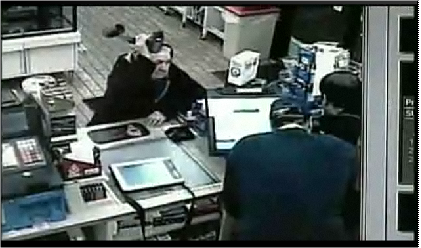
We agree with the police that attacking a robber is “not something we would recommend for anybody to do”. If you do choose to do so, swing the base of the barcode scanner stand (that’s where all the weight is)
Barcodes Key to Money-saving Idea for VA Hospitals
Nancy Fichtner, an employee of the Department of Veterans Affairs has won the first ever President’s SAVE Award. The SAVE Award is given to the Federal employeee with the best idea to save taxpayer dollars and make the government perform more effectively and efficiently.
Fichtner’s idea is to add a barcode to medicines that would allow a hospital patient to take the unused portions of medications such as ointments, inhalers, eye drops, and other bulk items home with them after discharge. These medicines are now being thrown away in many parts of the VA system because they lack adequate labeling for in-hospital and at-home use.
Fichtner’s idea was selected amongst over 30,000 entries. On Monday, December 21, Nancy will present her idea to President Obama at the White House.
Scanning Students

Â
Imagine a checkout line at your local grocery store, but with students lining up to be scanned instead of your groceries. That is the growing scene at college fairs across the country since the National Association for College Admission Counseling introduced barcode scanners at several of its National College Fairs.
The technology allows applicants to fill out their contact information online and can then print out their own personal barcode to take to the fair. In turn, colleges attending the fair can rent scanners, allowing students to swipe their barcodes at the colleges they are interested in. Universities can download an applicant’s information on the computer within 24 hours after the fair.