Replacing Consumer Tablets in the Warehouse
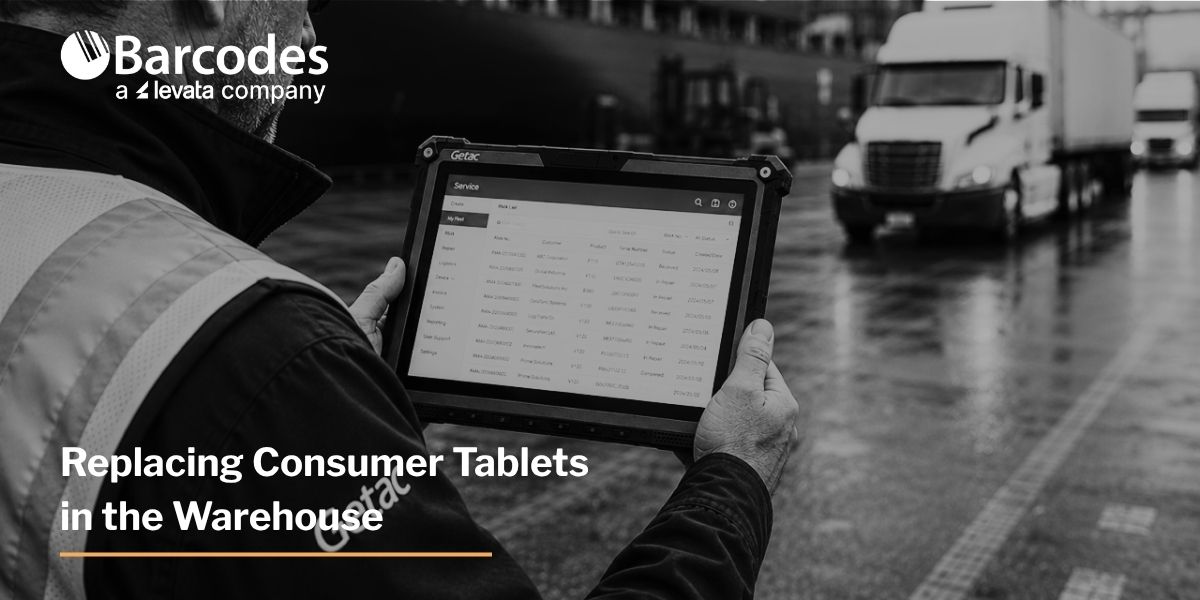
In a busy warehouse or distribution center, every minute counts. Forklift operators need immediate access to inventory data, warehouse management systems (WMS), and picking instructions. When a device freezes, loses connectivity, or takes several minutes to reboot, the impact extends well beyond the person holding the tablet. Forklifts sit idle, orders get delayed, and warehouse productivity takes a hit.
Yet many operations continue to rely on consumer-grade tablets that simply weren’t designed for the demands of industrial environments.
A rugged tablet for warehouse operations should combine industrial durability, dependable power, and compatibility with the applications employees use throughout their shifts. Getac’s ZX80 Android tablet and ZX80W Windows tablet offer two compact options for operations moving beyond consumer-grade hardware.
The right choice starts with your workflows, software, and deployment requirements.
Why choose a rugged tablet over a consumer tablet for warehouse work?
Rugged tablets are designed for physical conditions that can shorten consumer device life and interrupt warehouse workflows. Consumer tablets may cost less initially, but the purchase price tells only part of the story.
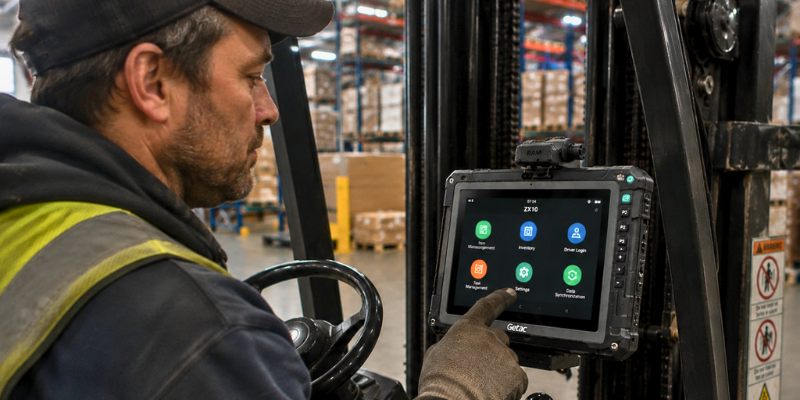
Warehouses expose devices to vibration, accidental drops, dust, spills, temperature changes, and extended daily use. Protective cases can help, but buyers still need to evaluate the complete device, battery, mounting, and accessory system.
| Warehouse requirement | Consumer tablet consideration | Rugged tablet advantage |
| Drops and vibration | Protection depends on device and case | Documented durability testing helps match hardware to conditions |
| Dust and moisture | Sealing varies by model | Published ingress protection ratings support informed selection |
| Multiple shifts | Charging may remove devices from service | Available battery swaps can reduce charging interruptions |
| Forklift deployment | Mounting and power require separate evaluation; slower boot times and unexpected reboots | Compatible industrial docks and power accessories support deployment |
| Lifecycle cost | Consider repairs, replacements, and reconfiguration costs | Evaluate potential savings from fewer interruptions and longer service |
Consumer devices can serve controlled environments. The business case for rugged hardware becomes stronger when device failures repeatedly interrupt receiving, picking, replenishment, or shipping.
How do the Getac ZX80 and ZX80W compare?
Getac rugged tablets are engineered from the ground up for demanding industrial environments. Rather than relying on protective cases to compensate for consumer hardware limitations, Getac builds durability directly into its devices. For warehouse and distribution operations, that means hardware designed to withstand the conditions operators encounter throughout their shifts.
The main difference is the operating system: the ZX80 runs Android, while the ZX80W runs Windows 11 IoT Enterprise LTSC on ARM. Both offer an 8-inch format for workers moving between warehouse aisles, material handling equipment, and loading areas.
| Feature | Getac ZX80 | Getac ZX80W |
| Operating system | Android | Windows 11 IoT Enterprise LTSC |
| Processor | Qualcomm QCS6490 | Qualcomm QCS6490 |
| Memory / storage | 12GB RAM / 256GB UFS | 12GB RAM / 256GB UFS |
| Display | 8-inch WUXGA, 1,000 nits | 8-inch WUXGA, 1,000 nits |
| Durability | MIL-STD-810H, IP67, 6-foot drop resistance | MIL-STD-810H, IP67, 6-foot drop resistance |
| Listed operating temperature | -20°F to 145°F | -20°F to 145°F |
| Wireless | Wi-Fi 6E; optional cellular | Wi-Fi 6E; optional cellular |
| Data capture | Optional 1D/2D barcode imager and NFC | Optional 1D/2D barcode imager |
| Power | Internal battery; optional hot-swappable second battery | Internal battery; optional hot-swappable second battery |
| Starting weight | Approximately 1.3 pounds | Approximately 1.3 pounds |
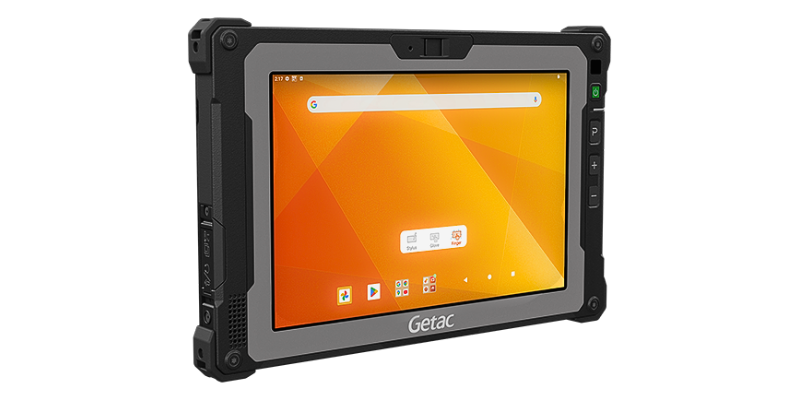
Getac ZX80 review: a practical fit for Android warehouse applications
The Getac ZX80 combines portability with industrial protection for teams using Android picking, inventory, and inspection applications.
Its bright display supports visibility when employees move between indoor work areas and sunlit loading docks. Optional barcode capture can consolidate scanning and transaction entry on one device, while available hot-swappable batteries support longer operating periods.
Fit assessment: Consider the ZX80 when an Android workflow needs more screen space than a handheld, with frequent movement between mounted and carried use.
Getac ZX80W review: a compact Windows option with a compatibility checkpoint
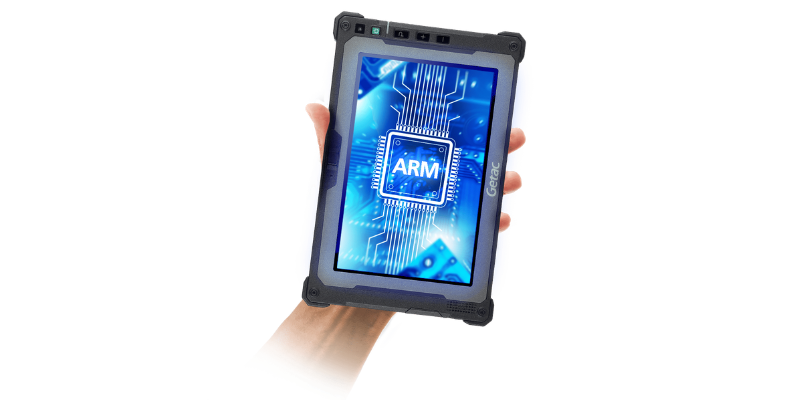
The Getac ZX80W brings Windows 11 IoT Enterprise LTSC to the same compact format. Its fanless ARM platform and long-term servicing approach make it worth evaluating for supported Windows warehouse applications.
Fit assessment: Consider the ZX80W when Windows is an application requirement, but validate the complete software stack. Confirm WMS clients, scanner and printer drivers, VPN tools, and management agents support the proposed Windows on ARM deployment.
Which warehouse and supply chain tasks can these tablets support?
Both models can support common warehouse tasks when paired with compatible applications, scanning equipment, and accessories.
| Workflow | How a tablet supports the task |
| Receiving and put-away | Review purchase orders, record discrepancies, confirm locations |
| Picking and replenishment | Display instructions and confirm quantities or destinations |
| Cycle counting | Compare physical stock with system records |
| Forklift operations | Keep inventory and task information at the point of work |
| Shipping and dock checks | Verify loads and capture damage photos |
| Yard and transportation coordination | Access assignments and record shipment status |
How do you calculate the ROI of a rugged tablet for warehouse operations?
When evaluating rugged devices, it’s important to look beyond the initial hardware investment. Compare total deployment cost with measured downtime, support effort, and replacement costs for non-rugged devices.
Consider a hypothetical operation losing 15 minutes per forklift each shift to startup and device interruptions. Across 50 forklifts and two shifts, that equals 25 equipment-hours per day.
Track interruption minutes, failed transactions, repair frequency, and IT support time. Include tablets, docks, scanners, batteries, software, deployment, and support in the cost comparison.
The real cost of a warehouse tablet includes the work that does not get done when it is unavailable.
Ready to Replace Unreliable Warehouse Tablets?
When consumer tablets repeatedly interrupt warehouse work, the next device decision should account for durability, application compatibility, and the cost of lost productivity. The Getac ZX80 and ZX80W offer two compact, rugged options for keeping information accessible wherever tasks take your team.
Whether your operation runs on Android or requires a compatible Windows environment, Barcodes, Inc. can help evaluate the right configuration, scanning accessories, mounting, and support.
Contact Barcodes, Inc. to discuss your warehouse mobility requirements and find the right Getac rugged tablet for your operation.
Frequently asked questions
1. What is the difference between the Getac ZX80 and ZX80W?
The ZX80 runs Android. The ZX80W runs Windows 11 IoT Enterprise LTSC on ARM. Choose according to validated application and peripheral compatibility.
2. Can these tablets be mounted on a forklift?
Compatible vehicle docking options are available. Confirm the dock, mounting location, power conversion, and safe operator sightlines for each vehicle.
3. Do the ZX80 and ZX80W include barcode scanners?
Both offer optional integrated 1D/2D barcode imagers. Confirm the selected SKU includes the scanning capability your workflow requires.
4. Can a Getac rugged tablet operate in cold storage?
Both list operation down to -20°F. Temperature ratings alone do not establish freezer suitability; validate condensation, accessories, battery performance, and actual transitions.
5. Will rugged tablets eliminate warehouse downtime?
No. They can reduce exposure to physical damage, but uptime also depends on network coverage, application performance, charging practices, and ongoing support.