


Barcoding News
Data tracking news, product updates, tips, and more
RFID: Track and Trace

Outsourcing continues to remain a dominant force throughout the pharmaceutical industry, as more companies than ever move to the “virtual world” of contract manufacturing. By incorporating outsourcing — a cost-effective, flexible approach to resource allocation and investment — into a company’s overall business strategy, pharmaceutical companies gain new opportunities to sustain long-term growth and competitive advantage. But the increasing globalization of the contract manufacturing market can lead to a rush to expand practices in low-cost countries, straining brand owners’ ability to manage and control their manufacturing, packaging and supply chain operations.
Despite outsourcing growth and the availability of Web-based tools, few manufacturing companies have successfully automated communications and operations to collaborate with suppliers, distributors and contract manufacturers. Instead, they still continue to rely on outdated processes that contribute to delays, errors and excessive inventory and costs.
To succeed with pharmaceutical outsourcing, a company must collaborate closely with partners. In order to succeed with collaboration, a company must have in place technologies and processes that improve control, visibility and velocity across the outsourced network — namely barcoding, radio-frequency identification (RFID) and track and trace capabilities.
Datalogic Gryphon 2D Plus Handheld Imagers used to Scan Drivers’ Licenses at Winn-Dixie
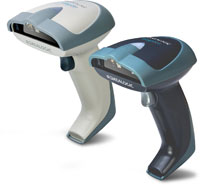
Datalogic Scanning is pleased to announce that Winn-Dixie Stores, Inc. is among the latest companies to select the Gryphon 2D Plus Imager for use in its 520-store Southeastern chain. The Gryphon 2D Plus Imager is helping Winn-Dixie improve upon its processes related to the sale of age-restricted items.
“With the new Gryphon 2D Plus Imager, we are now able to provide a higher level of service to our customers by speeding up the check-out process,†said Robin Miller, director of communications for Winn-Dixie. “The Gryphon 2D Plus Imager not only increases scanning speed, but it also enables our Associates to easily scan large items on the bottom of the shopping cart.â€
“In addition to the time-savings customers and cashiers will experience with the age-verification system, the Gryphon 2D Plus Imager is also equipped with the ability to read the new GS1 DataBar codes which are beginning to appear on produce and other variable weight items.â€,
Marc Lynn
Age-Verification using Drivers’ Licenses
“Retailers who sell regulated goods such as alcohol and tobacco must adhere to federal AAMVA standards to verify customer drivers’ license data, including age, date-of-birth, and license expiration date,†said Glen Feeley, Vice President, Sales – the Americas, for Datalogic Scanning. “Enabling retailers to comply with these regulations, the Gryphon 2D Plus Imager used in conjunction with Datalogic’s DL parsing logic, which is part of the Datalogic Aladdinâ„¢ software configuration program, eliminates manual data entry, increases efficiency at the retail point-of-sale, and prevents errors in the sale of controlled items.â€
Common Receipt Printer Interfaces
Use the chart below to identify what type of interface your receipt printer has.
Adapted from http://www.transact-tech.com/products/ithaca_8000_info_faq.html
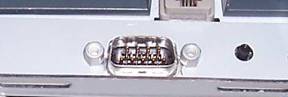 |
9 pin Serial InterfaceCable Required: |
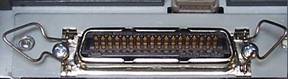 |
36 pin Centronics Parallel InterfaceCable Required: |
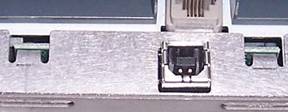 |
USB InterfaceCable Required: |
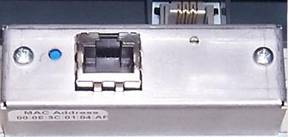 |
Ethernet InterfaceCable Required: |
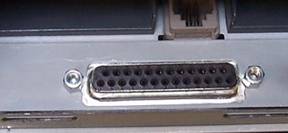 |
25 pin Parallel InterfaceCable Required: |
|
25 pin Serial InterfaceCable Required: |
 |
Caution: The 25 pin Parallel and 25 pin Serial interfaces look exactly the same externally. They both use a 25 pin D-shell connection. |
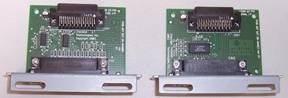 |
A closer look will reveal that the electronics on the actual interfaces boards are different. The best way to determine which 25 pin communication interface is present in the printer is to print a configuration listing from the printer. This listing will show either RS232 Serial or P1284 Parallel. See Manual Configuration for how to print out this listing. |
Datamax-O’Neil Portable Printers Become Wavelink-enabled for Device Management
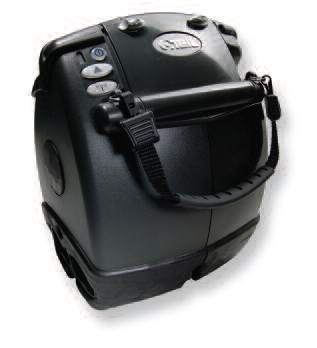 Partnership Provides Ease of Deployment and Integration into a Heterogeneous Networking Environment
Wavelink Corporation and Datamax-O’Neil today announced that Datamax-O’Neil has selected Wavelink® Avalanche Mobility Centerâ„¢ (MC) software to pre-load on all of its wireless, 802.11-enabled mobile printers. This partnership demonstrates Datamax-O’Neil’s commitment to continuously increase the efficiency of its enterprise printing solutions and further solidifies Wavelink’s position as the standard in wireless enterprise management.
Datamax-O’Neil customers are now empowered to deploy industry-leading management software from Wavelink to remotely monitor and configure their Datamax-O’Neil wireless printers, along with additional wireless devices on the network. Customers using Avalanche MC benefit from extensive management functionalities that include centralized remote management, performance monitoring, software distribution and crucial device security.
“Wavelink is a complete management solution that can handle multiple device classes and brands,” said Endre Vargha, vice president of engineering and general manager for Portable Products at Datamax-O’Neil. “Partnering with them enables users that have already deployed Wavelink Avalanche in their network to easily add and manage Datamax-O’Neil printers as part of that environment.”
Wavelink customers can now easily manage and configure Datamax-O’Neil printers through the same interface they use for their other wireless devices. The agreement also adds to Wavelink’s industry-leading network of hardware partners that represent the world’s largest mobile device manufacturers across a broad range of devices.
“The trend for companies to be more mobile and implement wireless technologies continues its strong growth. As the number and type of devices increases, the ability to manage them easily through a single interface becomes even more critical,” said Wavelink president Lamar Van Wagenen. “Datamax-O’Neil is well-recognized as a leader in wireless mobile printing, and our partnership continues Wavelink’s focus on providing powerful management tools that work seamlessly in diverse environments with several different product brands and device types.”
The Datamax-O’Neil 802.11-equipped mobile printers that have been integrated with Wavelink Avalanche Mobility Center include the microFlash family of portable printers, O’Neil Compact portable printers (OC2 and OC3), and the LP3 label printer.
Maximize the success of your restaurant with mobility

Whether your restaurant is large or small, or offers fine, casual or quickserve dining, your servers and managers will have the tools they need to capture, transmit and access information as needed, wherever they happen to be. As a result, overall operational efficiency is maximized. Productivity is improved through process automation, improving staff utilization. Servers and managers are more effective, able to take the right action at the right time to deliver a level of service that will not only set you apart from your competition — but will keep your guests coming back. And the ability to increase sales and the number of guests while substantially improving service enables restaurants all over the world to achieve a new level of success…and profitability.
Download whitepaper: Maximize the success of your restaurant with mobility
Coca-Cola Testing RFID on Coke Machines

Coca-Cola has begun beta-testing an RFID-enabled drink dispenser that the company claims will transform the soft drink dispensing industry, by providing more than 100 drink options from a single machine. The machine, known as Freestyle, utilizes RFID technology to identify 30 or more cartridges, determine the quantity of flavoring inside each, and transmit data back to Coca-Cola indicating which drinks are being consumed, and when.
“We consider Freestyle nothing short of a revolution in the fountain dispenser business,” says Ray Crockett, Coca-Cola’s director of communications. The system not only offers consumers a vast choice of Coca-Cola beverages, he notes—from sodas to flavored waters—it also provides the company with real-time insight into what is happening in restaurants across the United States.
Continue Reading: http://www.rfidjournal.com/article/articleview/4967
RFID Has Role Protecting Human Health
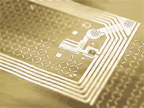
Coupled with collaborative technology, RFID can help manage efficient responses such as the recall of suspected food products and notifying affected parties. For example, a calf can now be tracked from birth to the slaughterhouse as it is in Australia, where the National Livestock Identification System legislation mandated, in 2005, RFID tagging for cattle stock.
There are even pilots where, combined with global positioning system (GPS) and “shock” technology, farmers can manage RFID-tagged cattle within certain geographical boundaries.
Let’s envision how RFID and collaborative technology can work together to help assure the quality of pork humans consume.
Barcode Print Solutions for Nurses
Barcode printing solutions that help nurses do what they do best: Provide excellent patient care
Thermal Barcode Printing Solutions That work with you and for you
Zebra thermal barcode wristband and label print solutions offer you and other members of your hospital’s nursing staff an easy way to improve patient safety. This is technology you’ll actually welcome, because rather than hindering your workflow, it actually helps you work more effectively. Consequently, you’ll have more time to do what you do best: care for the patient.
Performing together as a complete, optimal barcode print solution, Zebra thermal printers and genuine Zebra wristbands and labels encode patient data as a barcode and text. Scanning the barcode gives you immediate, automated access to patient information—helping prevent errors and improve patient safety
Cost Still a Hurdle for RFID
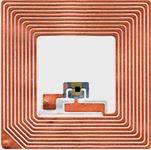
According to a survey conducted by Australia-based University of Wollongong’s Centre for Business Services Science, one reason companies adopt radio-frequency identification technologies is to gain an advantage over their rivals, and another is improved data accuracy. Companies that have not adopted RFID, however, cite the technology’s cost as one of the most important factors influencing their decision.
(Original article: http://www.smartbrief.com/news/comptia/storyDetails.jsp?issueid=6BBCD91D-F82A-4F8E-A30B-79D6476F5235©id=D42F4495-2E52-4B17-B810-DB06651E6965)
How Mobile Printers Drive Efficiency Throughout the Supply Chain
Today’s Reality—Closing the Productivity Gap
With an increasing emphasis on cost reduction, global enterprises are looking for ways to improve efficiency and accuracy in their supply and distribution chains. To remain competitive, distribution centers, manufacturers, and short-haul and long-haul carriers must change the way they label and track goods. Success depends on maximizing efficiency throughout all supply chain operations—front to back. Exploiting mobile labeling technology is fundamental to achieving optimal efficiency.
The most effective way to improve efficiency and keep labor costs under control is to minimize the amount of time required to label materials, work in process, finished products, boxes, and pallets. Centralized labeling solutions significantly reduces productivity and injects inaccuracies; thus, even the slightest improvement to the handling process will yield significant cost savings.
Barcode and RFID labels are by far the fastest and most accurate method to identify and track materials and products throughout the supply chain, and within warehouses and distribution centers. Used in multiple industries, centralized printing stations affix barcodes and RFID to the materials, finished goods, and packages. When integrated with enterprise resource planning (ERP) software, these systems are a proven solution for significantly boosting operational efficiencies and reducing costs. However, tightening the supply chain even further calls for mobile printing solutions that equip workers with seamless mobility throughout the warehouse—wherever and whenever they need it.
“By using mobile wireless printers at the receiving dock to issue goods receipts, Driscoll Strawberry Associates reduced the time to process receiving transactions by 25 percent.1â€
1. Zebra Case Study, “Driscoll Picks Perfect Mobile Solution for Distribution Account Reconciliationâ€