


Barcoding News
Data tracking news, product updates, tips, and more
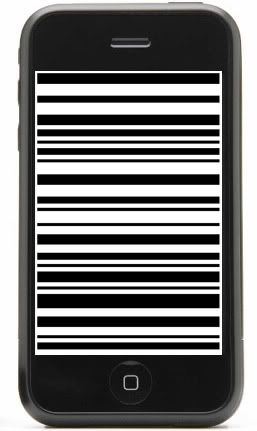
Barcode scanning with the new iPhone?
Â
When iPhone 3.0 comes out later this year, we’ll see iPhone apps tied to special-purpose accessories.
Imagine a universal remote that lets you use your iPhone to control every box in your home-entertainment system. Or a portable RFID- and barcode-scanning module that turns your iPhone into a tiny store clerk — or comparison shopper — letting you find and buy stuff just by waving your phone at it.
These are just two suggestions from Wired.com readers for accessory-powered iPhone 3.0 applications — or, to use the term we coined, dongleware. We put up a call for suggestions, and you responded with loads of great ideas. We figured, what better way to give wannabe-millionaire developers ideas — and get what consumers want in return? Win-win.
iPhone 3.0 won’t be launching until summer, but developers can get plenty done in two or three months. To help speed up the process, here are your top-voted ideas in a nice and tidy list. Drum roll, please.
Barcode/RFID/Magnetic-Stripe Reader
This idea got the most votes — an accessory that acts as a barcode scanner and maybe triples as a magnetic-card and RFID tag reader.
Here’s how it could be useful: It would essentially turn the iPhone into a miniature checkout stand. The barcode scanner would register a product’s price, and then customers can simply swipe their credit card into the magnetic card reader. Similarly, the radio-frequency identifier would scan products containing RFID tags, such as library books, and send that information to the iPhone. In theory, the iPhone app transfers the data via the internet to complete the transaction.
Wouldn’t it be interesting (and a little weird) to see iPhones or iPod Touches at the checkout counter of every store?
This could also make a great tool for consumers to do on-the-fly comparison shopping while they browse brick-and-mortar stores.
Intelligent Mail

WASHINGTON — Encouraged by a 90 percent customer approval rating, the U.S. Postal Service today announced that it would make the recent Intelligent Mail University Symposiums available through its RIBBS website: ribbs.usps.gov.
About 90 percent of the 1,000 attending the webinar symposiums rated the sessions as “Excellent†or “Good,†according to Pritha Mehra, vice president, Business Mail Entry and Payment Technologies.
The Postal Service facilitated the four symposiums — in Chicago, Los Angeles, Atlanta, and New York — to help its business customers prepare for the launch of Intelligent Mail services on May 18.
“We credit the success of the symposiums to so many of our customers whose input helped drive the content,†said Mehra. “We look forward to our continued working relationship with the industry through implementation and beyond.â€
By signing up for the services, and depending on the specific services selected, business mailers can receive automated address correction, enabling greater returns on investment for their direct mail campaigns. When combined with print production and logistics systems, Intelligent Mail services will provide mailers with the ability to track their mailings in the portion of the supply chain prior to the Postal Service. For example, they’ll know whether the mailing is still at the printer’s facility or has been inducted into the postal network.
The key technology behind the services is the Intelligent Mail barcode for letters and flats (large envelopes, magazines, catalogs, and circulars). The barcode’s enhanced data capacity allows it to hold all routing and sorting information as well as to provide each mail piece with the ability to be identified uniquely within a mailing.
The Postal Service also has developed Intelligent Mail barcodes for trays, sacks, and containers.
“The ability to track the status of a mailing will help business mailers respond more quickly and more accurately when their customers call,†said Tom Day, senior vice president, Intelligent Mail and Address Quality. “Since the Intelligent Mail barcode also enables the tracking of envelopes from a recipient back to the mailer, it can help finance departments monitor and predict payments more easily.â€
RFID Asset Tracking System Streamlines Asset Management

Â
This RFID asset management system, basing on 13.56MHz, integrates best asset tracking practices with RFID asset tracking tags and multi-tag RFID readers. With this RFID tracking system, assets can be secured and tracked automatically as they move throughout the areas.
RFID tags are integrated as part of this passive RFID asset tracking system. There are series of RFID asset tracking tags that are fit for different enviroment. Each DAILY’s RFID tag has a unique ID for the security of asset mangement.
To take inventory, handheld RFID reader DL8033 and fixed RFID reader DL810 is used to track the tagged assets in the RFID asset tracking system. And RFID reader DL8033 is used to receive and collect asset data while RFID reader DL810 gives the real-time monitoring and alerting to improve the security of this RFID asset tracking system.
This RFID asset tracking solution can be deployed and tracked automatically to maximize asset utilization, thus reducing error and the time of finding items.
Designer Barcodes for Designer Products

Tokyo based creative agency SET is adding style to the standard QR code. Teaming up with Takashi Murakami, they have created a custom code that mixes one of Takashi Murakami characters with the Louis Vuitton pattern.
Â
‘National Post’ First North American Newspaper to Adopt 2D Barcoding

Toronto-headquartered National Post Tuesday said it has become the first North American newspaper to adopt a 2D barcode system that allows readers to scan the printed paper with a mobile device to get updated digital content.
The National Post is using Scanbuy’s ScanLife client application and Code Management Platform for the system.
Readers with data-enabled camera phones, such as a BlackBerry, can scan the or take a snapshot of the digital-looking barcode found alongside a Post story. Updated content from the newspaper’s mobile site is then uploaded to the mobile device.
“The brilliant thing about ScanLife is how it ties our newspaper and our mobile site together,” Post Vice-President/Digital Media Jonathan Harris said in a statement. “With ScanLife, our readers can use their smartphones to dig deeper into the story on our mobile site while they are reading the paper. At the Post, we are always searching for new and innovative ways that make it easier for our readers to connect with our stories. This new technology helps us do just that.”
The ScanLife application can be downloaded for free from www.getscanlife.com, and used to take a photo or scan any 2D barcode in the Post.
In addition to updating news, the Post said the 2D barcode technology could be used for contests and advertisements.
“We are very excited that a national daily newspaper is embracing this technology to seamlessly connect one media platform to another,” Scanbuy CEO Jonathan Bulkeley said in the announcement. “This represents a more holistic approach to media which we believe 2D barcode technology can help facilitate.”
New RFID Tracks, Monitors Nuclear Materials

Radio frequency identification (RFID) devices have widely been used for tracking for years; recently, scientists from U.S. Department of Energy’s (DOE) Argonne National Laboratory have developed a unique tracking technology that monitors the environmental and physical conditions of containers of nuclear materials in storage and transportation.
“RFID technology is ideally suited for management of nuclear materials during both storage and transportation,” said Yung Liu, Ph.D., Argonne senior nuclear engineer and RFID project manager. “Key information about the nuclear materials is acquired in real-time,” he explained in a March 24 press release.
Data on the status and history of each individual container are available with a click of the mouse and can be used to augment and modernize DOE’s existing management systems for nuclear materials.
“The Argonne system can simultaneously monitor thousands of drums 24 hours a day, seven days a week. Any abnormal situation, such a loss of seal, a sudden shock, a rise in temperature or humidity, can trigger an alarm for immediate action,” Liu explained.
The monitoring of tens of thousands of radioactive and fissile material packages has been a challenge for DOE to ensure accountability, safety, security, and worker and public health.
The system is comprised of active transponders, or tags with long-life batteries ( greater than 10 years), on each package, readers that collect information from the tags, control computer, and application software. The information is constantly updated and communicated via a secured network, thus decreasing the need for manned surveillance.
This RFID technology also has applications outside the nuclear field and may be used for other hazardous materials or any valued material, according to Liu.
“This new Argonne RFID technology, expected to be patented, has applications in many industries, and as the technology is further developed, its usefulness is bound to grow,” Liu said.
Basket-at-once scanning technology exists, but retailers aren’t biting

At this year’s NRF show, the company 5stat demonstrated an RFID-based application for apparel retailers which scanned an entire counter full of clothing into the POS instantaneously, eliminating the need to drag each item across a barcode scanner. Microsoft has a similar demo unit in its Retail Experience Center that rings up copies of Windows Vista and Halo Wars in a blink; IBM has two such fully functional test labs for retailers, one in southern France, the other in New York.
It is incontrovertible that from a technology standpoint, basket-at-once scanning is available today. But the business case isn’t there yet, and the sad irony is that the retail segment that stands to benefit from it the most — supermarkets and grocery — will likely be the last to see it, if it does at all, thanks to some unique challenges.
“I’ve seen the demos, but to my knowledge, there is no retailer that has item-level RFID tagging on all live SKUs, which would be a prerequisite for a shopping cart scan-at-once,” said Jason Goldberg, vice president of marketing at retail design firm MTI.
Getting RFID tags into the supply chain
The stumbling block is not a technology one, and it is no longer really a cost one — tag prices are hovering close to the $.05 to $.08 range that most pundits said would be the “magic number” for mass adoption. The big problem, it seems, is finding a logical and cost-effective way to get the tags onto the products themselves.
The perfect scenario involves retailers getting their suppliers to put tags on the products before shipping them to the stores.
“If you have a retailer that is selling 50 different brands of apparel, the challenge is, they have to work with all 50 suppliers to tag their products,” said Himanshu Bhatt, global solutions executive and program director for IBM sensors and actuators. “But if you have a branded apparel retailer, the ones that have their own manufacturing, they have their own captive supply chain” and can integrate tagging as the last step in the manufacturing process.
Of course, those retailers with 50 brands can always slap the tags on the shirts themselves, but in doing so miss out on many of the supply chain benefits that item-level tagging provides above and beyond basket-at-once scanning, making it less of a value proposition.
Goldberg said few retailers have even come close to tagging enough of their products to make basket-at-once scanning a possibility.
“In my estimation, it will be some time before we see it,” he said.
Nokia launches beta of ‘Point & Find’ system for mobile phones, letting consumers scan images for search with their camera phone.
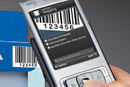
Nokia has launched a beta of its new Point & Find system, which lets mobile phone users search for information on an object by looking at it with their handset camera.
While the service could eventually let consumers scan barcodes, at the moment Point & Find is focused on movies.
Philipp Schloter, Nokia’s general manager for Point & Find, explained: “Simply by pointing their camera phone at a poster for a new movie, people can watch the trailer, read reviews, and find the closest cinema where it is playing.â€
Other uses suggested by Nokia include scanning barcodes for prices, looking at items for sale and being sent more details on where to shop or coupons, or eyeing objects in a museum and being sent multimedia information about it.
The open platform system uses the camera to look at images, GPS positioning to decide where it is, and the internet to search though a database of tagged objects. When an image is recognized, links to content – such as film times or prices – are sent back to the user.
Nokia doesn’t just want consumer feedback, but is looking to hear from businesses about their ideas for the tech – click here for the Point & Find business site. It’s already being used by the Body Worlds exhibition at the O2 in London, so pointing the camera of a Point & Find phone at related advertising should bring up data on the show.
The service can currently be downloaded in the US and the UK, on selected handsets. The phones supported by the current beta are the Nokia N82, N95, E66, N81, N76, E51, 6290, 6124 Classic, 6121 Classic, 6110 Navigator, and the 5700 Xpress Music.
Zebra Technologies announces ZXP Series 8 retransfer card printer

Photo-quality images and best in class print speed puts it in a class of its own
ZXP Series 8 printer along with new design software offers faster throughput, true over-the-edge printing, software tools for easier application integration, broader customer reach
Lincolnshire, Ill., March 31, 2009— Zebra Technologies Corporation (Nasdaq: ZBRA), a global leader in specialty printing and automatic identification solutions, announces the Zebra ZXP Series 8™, a revolutionary retransfer printer that offers a host of options for smart card encoding and
networking making it ideal for such applications as high security ID cards, driver’s licenses, gift cards and financial cards. The Zebra ZXP Series 8 produces photo-quality cards at nearly twice the speed of other retransfer printers currently on the market
Unlike its counterparts, the ZXP Series 8 printer delivers photo quality, over-the-edge, high speed printing on many different types of cards, including those with uneven surfaces such as smart cards, polycarbonate cards for security applications, and biopolymer cards. The printer is available in
single- and dual-sided printing configurations with a full portfolio of magnetic encoding, smart card encoding, single- and dual-sided lamination, and connectivity options.
Datalogic Scanning Unveils PowerScan PBT7100 Cordless Rugged Imager

The PowerScan® PBT7100 Industrial Bar Code Imager incorporates Datalogic’s Patented “Green Spot†and Cordless Bluetooth® Wireless Technology
Eugene, OR, March 9, 2009 – Datalogic Scanning is pleased to announce the immediate availability of the next generation affordable PowerScan® PBT7100 industrial handheld linear imager. Offering best-in-class performance, the PowerScan PBT7100 reader is ideal for high-volume mobile industrial applications at instinctive as well as long range reading distances. This new imager is the perfect solution for users that require a snappy, rugged and durable handheld cordless scanner with best-in-class performance and features in an ergonomic, robust, and IP65 rated enclosure.