


Barcoding News
Data tracking news, product updates, tips, and more
Operation: Improve Asset Management
From weapons to desks and chairs, the U.S. Army relies on the Property Book Unit Supply Enhanced (PBUSE) system to track Army assets and automate property accountability processes across the supply chain while providing for greater visibility of these assets. PBUSE, the U.S. Army’s Web-based property accountability and tracking system, is part of the Global Combat Support System for both garrison and tactical units. Intermec solutions are at the core of helping PBUSE minimize their inventory tracking costs.
The Intermec solution consists of the CK61 rugged mobile computer and the PM4i Thermal Printer. This solution covers close to 13,000 military locations and manages tens of millions of inventory items for the Army at any given time. By minimizing the footprint cost on and off the battlefield, the Intermec solution has improved inventory asset management by 80 percent, saving the U.S. Army over half a million dollars in permanently lost or misplaced inventory and additional costs to individual soldiers.
At a critical time in the U.S. Army’s history with two major wars taking place, the Army has no room for error when it comes to keeping track of equipment on the battlefield, as well as, in the warehouse. However it has become increasingly difficult to track inventory, particularly as it relates to deployed units. Due to a paper-based, data entry, receipt system, PBUSE has been hampered by inefficient asset tracking processes used to confirm inventory.
Datamax-O’Neil’s Microflash 4t printer Makes NYPD Parking Citations More Accurate and Efficient
Cautionary words to those who park in New York City— obey the rules, or pay the price. A computerized parking citation system rolling out to the NYPD’s parking enforcement division will effectively eliminate hand-written traffic tickets. The result: a more accurate, efficient and cost effective solution. City officials say the new system will significantly reduce errors associated with hand-written tickets and, according to some estimates; realize millions in unpaid fines owed the city.
The solution consists of Symbol Technologies’ handheld computer, the PPT 2800, and Datamax-O’Neil’s portable Microflash 4t thermal printer. The terminal’s pocket PC platform and features, including bar code scanning and real-time wireless communications, allow officers to scan vehicle registration stickers, print tickets, and upload the information to a central database.
The solution works well in New York City, as New York State requires that all vehicles have their registration affixed to the inside of the windshield. The registration includes a 2-D barcode, which the parking officer scans using the handheld computer, and information about the vehicle is instantly and accurately captured. A traffic summons is printed on the spot by the wearable thermal printer, which is connected to the PC via a wireless LAN.
Invisible Barcodes for Security and Inventory Management Applications
Kodak is introducing a new virtually invisible clear ink. KODAK NEXPRESS Red Fluorescing Dry Ink is clear to the naked eye, but becomes red fluorescing when illuminated with an appropriate ultraviolet (UV) light source. The ink can be used to print unobtrusive images and non-reproducible bar codes on various printed materials, which then can be read with specialized bar code readers. The NEXPRESS Red Fluorescing Dry Ink enables a wide range of security and inventory management applications, including certified documents, such as medical prescription pads, drivers’ licenses and event tickets.
“This innovative expansion of the NEXPRESS Fifth Imaging Unit Solutions allows digital print service providers to enter the lucrative and growing secure documents and ‘track and trace’ markets,†said Steve Fletcher, General Manager, Electrophotographic Printing Solutions, Vice President, Kodak. “The amazing versatility of the family of KODAK NEXPRESS Digital Production Color Presses is designed to help print service providers stay on the forefront of a demanding, quickly changing marketplace.â€
Decode Zone for the MC9000 Equipped with a Lorax 1D Long Range Barcode Scanner
The SE-1524ER “Lorax” is the barcode scanning engine that is used in some models of the Motorola MC9000 Series and other 1D long range barcode scanners. The SE-1524ER depth of field diagram shows the decode zone information.
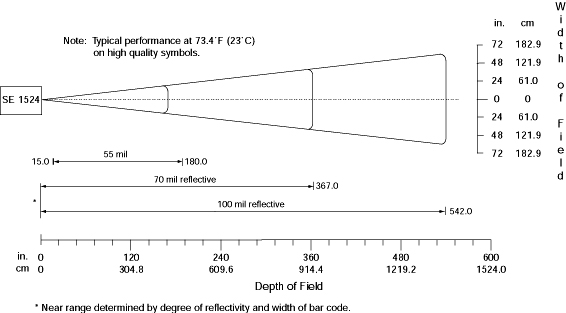
With a large and reflective barcode, scans can be made successfully up to 45 feet away!
Great Styles, Great Service, and Great Gift Cards Printed on Site with Zebra Card Printers Print Gift Cards on Site for shopLAstyle.com
Cynthia Rojas’ original concept behind shopLAstyle.com was to create a site that features great Los Angeles based designers.
“Some great designers, such as Louis Verdad, Gorjana, and Vince, are based out of LA and we were very excited to be one of the first sites to ever carry these lines,†explains Rojas. “Later, we came across terrific lines such as Rebecca Taylor and Notify, who happen to be based out of New York and Italy respectively, and we just couldn’t pass them up. So, although we mainly carry Los Angeles designers, we won’t pass up lines that aren’t LA based.
“We provide our customers with great clothing from a variety of designers and an easy to use site that gets orders quickly to our customers, for which we get raves,†adds Rojas. “From simple C & C California tees designed by two California girls to the sexy, yet feminine, designs of Sass and Bide, designed by two Aussie girls, ShopLAstyle has evolved into a site that is dedicated to showing our customers exciting fashions that can’t necessarily be bought elsewhere.
“Because fashion is constantly changing, so does our site. We receive new merchandise on a weekly basis so customers check back often and sign up for our mailing list to receive emails about new items and special offers,†Rojas emphasizes. “That’s why we felt it was so important to create our own gift cards on site and on-demand. Buying a large quantity of pre-printed gift cards from an outside vendor didn’t make sense to us.â€
The solution to the client’s ID verification issues was to create a custom application that would provide real-time verification of ID credentials and access authorization using wireless portable data terminals and Zebra P640i card printers. The enhanced features of the P640i enabled the issuance of highly secure ID badges that serve both as employee identification and access verification. While the current system utilizes bar code technology to verify each distinctive credential, it is designed to accommodate migration to new ID cards armed with UHF RFID technology. UHF RFID credentials enhance ID verification by leveraging time and distance as factors in data recognition and retrieval.
Zebra Mobile Printers and Motorola Mobile Computers Help Chicago Gasoline Hauling Company Improve Efficiency and Service to Customers
McMahon Cartage is a gasoline hauling and delivery company that services gas stations and trucking companies in the Chicago area. It employs 32 drivers to deliver approximately 5. 5 million gallons of gas a week to more than 300 gas stations.
Challenge
Three years ago, McMahon Cartage determined that its delivery system was inefficient and decided to streamline the process. “In the old system, a gas station owner called the distributor; then the distributor called us and we entered the load into the system; finally, we called the driver to give him the information,†John McMahon, vice president of McMahon Cartage, explains. “Each delivery had to go through four people before it made it to the driver. As a result, there was a lot of miscommunication and wasted time. â€
“Because we had so many steps in the process,â€McMahon continues, “there were more chances of making mistakes. Plus, we had no way to track our orders. If something went wrong, everyone was pointing fingers at someone else. â€
In addition to the lack of accountability, drivers often got lost on their routes or wrote down the wrong name of the gas station on their order, resulting in the driver being held responsible for the billing inaccuracy, which could mean as much as $30,000 taken out of his or her paycheck.
“I spent a lot of time organizing the drivers’ schedules. In order to keep route errors down, I placed drivers only on routes that were familiar to them,†notes McMahon. “I wanted to ensure that our drivers could focus on driving safely to their destinations instead of having to worry about looking down at a map or getting lost. â€
So, the company began searching for a solution that would track orders more efficiently and make deliveries faster, as well as minimize the time customers spent placing orders.
Solution
McMahon Cartage selected an integrator of wireless, bar code and mobile solutions, to establish an online ordering system for scheduling delivery to gas stations. With Digital Fuel Solutions, the Web-based program developed by McMahon Carthage, delivery process time has been cut in half by allowing customers and distributors to order their gas online. The online orders are then given directly to the drivers via a Motorola® handheld device. After the driver delivers the gasoline, he prints a receipt using a Zebra® printer, eliminating errors and illegible writing.
Zebra RW 420 Takes the Cake in Head-to-Head Printer Comparison at Tastykake
About Tastykake
In 1914, a baker and egg salesman decided to join together to produce baked goods with the freshest ingredients. When the baker’s wife deemed the results of their efforts “tasty,†Tastykake was born. Now, the Philadelphia-based company sells more than $250 million worth of cakes and pies annually across the East Coast.
Challenge
With nearly 500 delivery routes, Tastykake brings fresh baked goods to hundreds of stores every day. The faster that drivers can restock each location, the more stops they can make in a day.
Drivers use Motorola® MC9000 handheld mobile computers to log the inventory coming off and onto store shelves. As they bring in new products, they print out invoices for each store on printers back in their trucks.
In an effort to improve efficiency, reduce costs, and add new capabilities, Tastykake began looking at new mobile printers.
New Intermec PF8 Printer Features Reduce Deployment Time and Improve Network Connectivity
Intermec Technologies today announced enhancements to its PF8 desktop thermal printers – including internal Ethernet and Intermec PrintSet configuration support. The new features streamline printer deployment and minimize maintenance for light duty applications in transportation/courier, manufacturing, healthcare, in-store retail and office environments.
“The PF8 chosen by GeoPost, perfectly meets the need to identify express parcels using barcodes, for customers dealing with tens to hundreds of parcels per day,” Jean-Luc Defrance, group chief information officer of GeoPost. “The printer is compact and easy to use which makes it the perfect solution for customers dealing with a large volume of express parcels. Its compatibility with the Intermec PC4 printer is a very useful extra function.”
Intermec PrintSet provides a simple mechanism for configuring printer and network settings, downloading fonts and graphics and upgrading firmware – saving time for both set-up and ongoing support. The PF8 printers, available in thermal transfer (PF8t) and direct thermal (PF8d) technology models, include flexible, industry standard connectivity – including parallel, serial, USB and optional internal Ethernet – enabling easy, drop-in installation in networked environments.
Two Options for Mobility: Mobile Devices and Mobilized Devices
Why Mobility?
Without mobility, business processes are tied to a desk and paper is used to distribute information. A paper driven process requires data to be handled many times leading to inefficient use of time with a greater chance of costly errors.
Option 1: Mobile Devices
A business processes can be performed in a mobile environment using devices designed for mobile use, such as handheld computers or belt worn printers.
Option 2: Mobilized Devices
If you require:
- High Volume Printing (over 100+ labels per day)
- Thermal transfer labels
- The use of a printer AND PC
- A full LCD screen display
A Mobile Powered Cart by can provide the ideal solution.
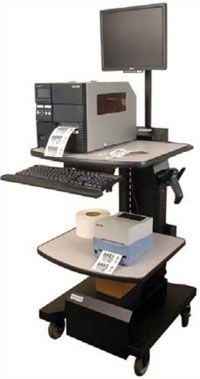
A Mobile Powered Cart is designed to hold and power up to (4) pieces of existing hardware for 8 – 12 hours of normal use. (This enables “on-demand” label printing with a high-volume thermal printer.) The workstation or “Mobile Desk” is completely modular and can accommodate an LCD Screen holder, CPU holder, laptop holder, adjustable keyboard tray, barcode scanner holder and much more.
Newcastle NB Series Mobile Powered Carts used for Mobile High-Volume Printing Stations
“Operators would attempt to carry multiple tickets and other documentation back and forth to the parts staging. There were significant quality issues of wrong paperwork being attached to the wrong job.â€
About the Company*:
The company is a leading global manufacturer of agricultural and construction equipment with about 11,300 dealers in 170 countries and net sales of ~$18.5 billion.
*It’s the customer’s policy to keep the company name withheld.
With 1.3 million sq. ft of office, warehouse and yard space, the Indianapolis Distribution Center (IDC) located in Lebanon, IN is the company’s largest depot in North America, stocking over 240,000 sku’s.
Application Description:
The IDC receives multiple large shipments and then ships smaller orders to their regional distribution centers throughout North America.
Challenge:
There was one central area where 8 – 9 operators would walk to 1 stationary PC/printer station. Here, they would print multiple product labels, depot tickets, routing tickets, and other documentation.
According to the IDC’s Ops Manager, “Operators would attempt to carry multiple tickets and other documentation back and forth to the parts staging. There were significant quality issues of the wrong paperwork being attached to the wrong job.”