


Flexible Industrial Label Printing for Barcode, RFID and Compliance Labeling
Labeling requirements rarely stay confined to one application. A manufacturing facility may need durable barcode labels for work-in-process tracking, RFID labels for automated inventory visibility and compliance labels for finished goods. A warehouse may print shipping labels, pallet labels, location labels and RFID tags—sometimes from the same printing station. Healthcare organizations must support patient identification, specimen tracking, asset management and regulatory labeling while maintaining accuracy in demanding environments.
Managing these varied requirements with separate printers can add unnecessary cost and complexity. Organizations increasingly need flexible industrial label printers that can produce a wide variety of high-quality labels, support multiple media types and integrate with barcode, RFID and compliance workflows.
The right printer should do more than produce a readable label. It should deliver consistent output at production speeds, accommodate changing label formats, connect to existing systems and withstand continuous use in challenging operational environments.
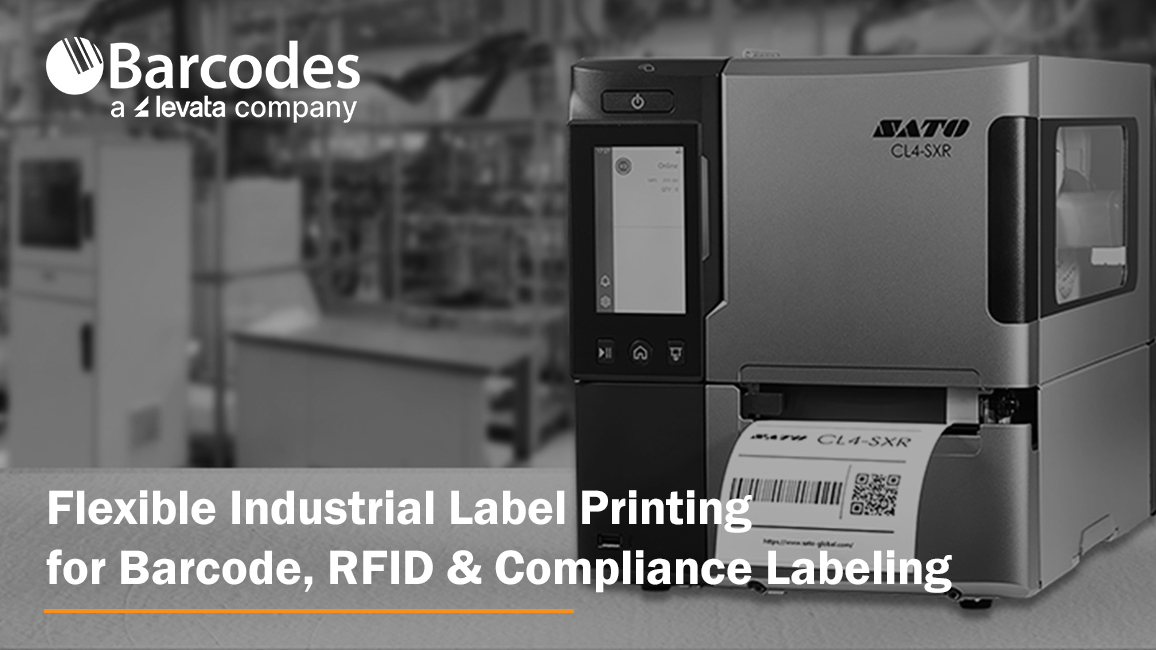
Let’s learn more about industrial label printing, and how front-runners like the SATO CL4-SXR and CL6-SXR.
What Features are Most Important for an Industrial Label Printer?
A flexible industrial label printer can adapt to different applications without forcing an organization to invest in a separate device for every label size, material or identification technology.
Important capabilities include:
- Support for multiple label widths, materials, ribbons and adhesive types
- High-resolution printing for text, graphics, barcodes and regulatory information
- Accurate media positioning for small or precisely formatted labels
- RFID encoding and verification options
- Reliable performance during long or high-volume print runs
- Connectivity with critical operating systems used for warehouse, manufacturing and healthcare
- Easy maintenance that limits disruption to critical workflows
- Remote management for printers deployed across multiple locations
Print width is another important consideration. Four-inch industrial printers accommodate many standard barcode, product, shipping and RFID labels. Six-inch printers provide additional space for pallet labels, chemical labels, automotive documentation, healthcare forms and other applications that require larger formats or more information.
Flexible Printing for Barcode, RFID and Compliance Labels
Industrial label printers must produce crisp, precisely positioned barcode labels that scan reliably at speed. Consistent print quality helps prevent rescanning, relabeling and data-entry errors across product identification, inventory, shipping, asset tracking and healthcare workflows.
For RFID applications, printers must accurately print, encode and verify each tag. Supporting both barcode and RFID labels gives organizations the flexibility to improve inventory visibility, shipment verification, traceability and asset tracking without maintaining separate printing platforms.
Compliance labels add requirements for legible text, symbols, barcodes and safety information. Precise printing and flexible media handling help businesses meet industry, regulatory and customer standards for applications ranging from product and chemical labeling to medical devices, food traceability and retailer-mandated shipping labels.
Label Printing in Demanding Operational Environments
Manufacturing, warehouse and healthcare environments have distinct labeling requirements, but all depend on reliable performance:
- Manufacturing: Printers must withstand dust, temperature changes and continuous workloads while producing readable labels for production, inspection, traceability and distribution.
- Warehousing: Printers must support high-volume receiving, picking, packing and shipping without interruptions that create backlogs or delay fulfillment.
- Healthcare: Printers must deliver accuracy and reliability across specimen, medication, medical device, supply, equipment and patient-identification workflows.
Beyond print speed, organizations should evaluate print accuracy, environmental adaptability, media compatibility, ease of maintenance and integration with existing systems.
SATO CL4-SXR and CL6-SXR: Top Choices for Flexible Industrial Labeling
For organizations seeking an industrial printer platform that can support varied barcode, RFID and compliance applications, the SATO CL4-SXR and SATO CL6-SXR are compelling options.
The third generation of SATO’s CL industrial printer platform combines high-speed printing, precise media handling, connected management and RFID capabilities. The CL4-SXR offers a four-inch print width for widely used label formats, while the CL6-SXR expands the print width to six inches for larger labels and information-intensive applications.
Together, the two models give organizations the flexibility to standardize around a common printer family while addressing different label dimensions and workflow requirements.
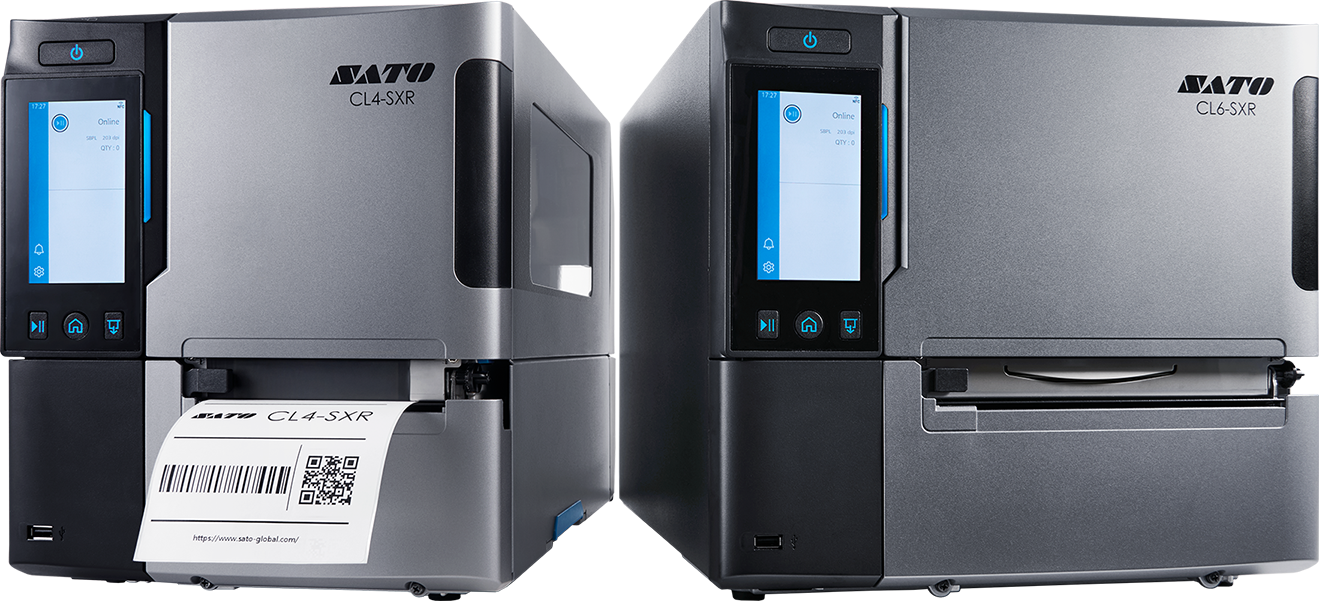
SATO CL4-SXR vs. CL6-SXR: At-a-Glance Comparison
| Feature | SATO CL4-SXR | SATO CL6-SXR |
|---|---|---|
| Print Width | 4-inch format | 6-inch format |
| Max Print Speed | Up to 18 inches per second at 203 dpi | Up to 14 inches per second |
| Print Accuracy | Up to +/- 0.3 mm | Up to +/- 0.3 mm |
| Best Suited For | Barcode, RFID, product and shipping labels | Larger labels requiring more space for data, graphics or compliance information |
| RFID Support | HR and UHF RFID | UHF RFID |
| RFID Capabilities | Print, encode and verify | Print, encode and verify |
| Media Handling | Supports thin, small, irregularly shaped and strongly adhesive labels | Supports varied media, ribbons and wider label formats |
| Print-quality Controls | GAP2 label-positioning sensor with temperature and humidity sensing | GAP2 label-positioning sensor with temperature and humidity sensing |
Shared Operational Advantages
- Accurate output: Precise positioning supports small labels, closely spaced layouts, barcodes, text and RFID inlays.
- Consistent print quality: Environmental sensing automatically adjusts thermal-head output as temperature and humidity change.
- Flexible media options: A redesigned peel-off mechanism and adaptable media configurations accommodate applications ranging from paper shipping labels to specialized product, compliance and asset labels.
- RFID quality control: Integrated verification identifies defective RFID tags before they enter production, warehouse or shipping workflows.
- One adaptable platform: Support for conventional and RFID labels helps organizations address current barcode requirements while preparing for expanded RFID adoption.
Connected, Serviceable and Resource-Efficient Printing
The SATO CL4-SXR and CL6-SXR combine connected management, proactive maintenance and waste-reduction features to support more efficient operations:
- Streamlined integration: SATO Application Enabled Printing allows applications to run directly on the printer, potentially eliminating the need for a separate computer in certain workflows.
- Flexible connectivity: Gigabit Ethernet, Bluetooth and optional Wi-Fi 6E support deployment across production lines, warehouse zones, healthcare departments and multiple facilities.
- Remote management: Remote desktop functionality simplifies access to printers installed in unattended or difficult-to-reach locations.
- Predictive maintenance: SATO Online Services uses AI-assisted monitoring to anticipate service needs, including thermal printhead replacement, before failures disrupt operations.
- Simplified servicing: Tool-free thermal head and platen roller replacement helps reduce maintenance time and restore printing more quickly.
- Less material waste: Printing can begin with the first label on a newly loaded roll, while recycled resin represents 34% of CL4-SXR components and 36% of CL6-SXR components.
A Versatile Platform for Evolving Labeling Requirements
The ideal industrial label printer should support what an organization prints today while providing the flexibility to accommodate new label formats, materials, identification technologies and compliance demands.
Whether the requirement involves barcode labels, RFID tags, compliance labels or a combination of all three, the SATO SXR series provides a flexible industrial printing platform designed for demanding operations. These capabilities make them top choices for manufacturing, warehouse, logistics and healthcare organizations that depend on high-quality labels to keep products, assets, inventory and information moving accurately.
Learn more about the SATO CL4-SXR and CL6-SXR and find the right configuration for your labeling applications.