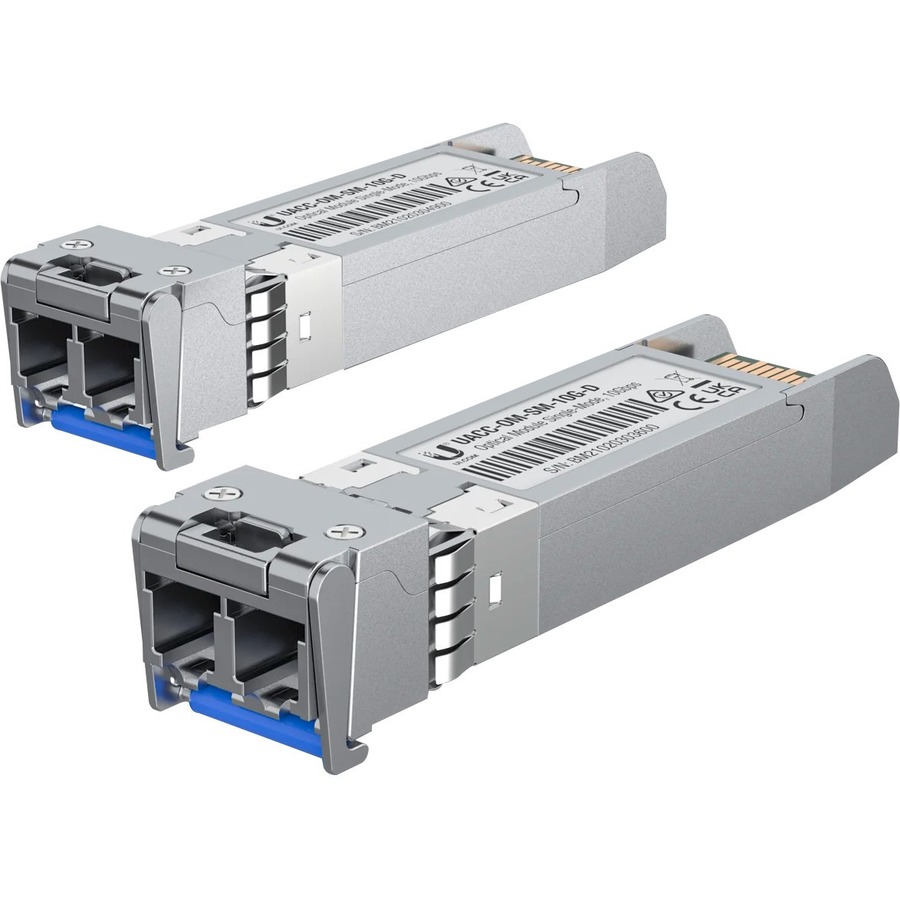
Application/Usage:
- Data Networking
- Optical Network



The Ubiquiti UACC-OM-SM-10G-D-20 supports a maximum distance of 32,808.40 feet (approximately 10 kilometers) over single-mode optical fiber. This extended reach makes it ideal for long-distance data center interconnections and campus network aggregation links.
This module features a 1 x LC Duplex connector, which is the standard small form-factor connector for high-speed optical networking. The LC duplex design allows for both transmit and receive connections in a compact footprint.
Yes, this transceiver module is fully compatible with 10 Gigabit Ethernet networks, supporting the 10GBase-X standard at 10 Gbit/s data rates. It operates at 1310 nm wavelength on single-mode fiber, making it suitable for long-distance 10GbE deployments.
The module operates at 1310 nm wavelength, which is a standard long-wavelength used for single-mode fiber optic communications. This wavelength is optimized for extended-distance transmission over single-mode fiber infrastructure.
Yes, the UACC-OM-SM-10G-D-20 is designed for both data networking and optical network applications. It provides reliable 10 Gigabit Ethernet connectivity for network infrastructure requiring high-speed optical interconnection.
This transceiver module is designed for single-mode optical fiber, which provides superior distance and performance characteristics compared to multi-mode fiber. Single-mode fiber is the preferred choice for long-distance 10 Gigabit Ethernet links in enterprise and data center environments.