


Barcoding News
Data tracking news, product updates, tips, and more
Long Range, Accurate RTLS with Zebra’s WhereNET Solutions
 Tracking and managing valuable assets is major concern for many industries especially in manufacturing and warehouse environments. Whether you’re tracking a work-in-process or general inventory and assets, the greater accuracy and closer to real-time visibility you can achieve is directly connected to business success.
RFID-based systems provide an immediate and non-line of sight means to capture your inventory or asset collection. However, the most common passive RFID tags and readers have a limited range and still require a user to scan the tags or pass them through a fixed reader portal. This is where Zebra’s WhereNET active RFID solutions can provide the range that can be used over your entire facility, yielding maximum coverage. With maximum coverage you will have real-time visibility into your entire business and operations, providing you with actionable data in order to make smarter decisions.
Don’t Let EMV Chargebacks Cut into Your Profits
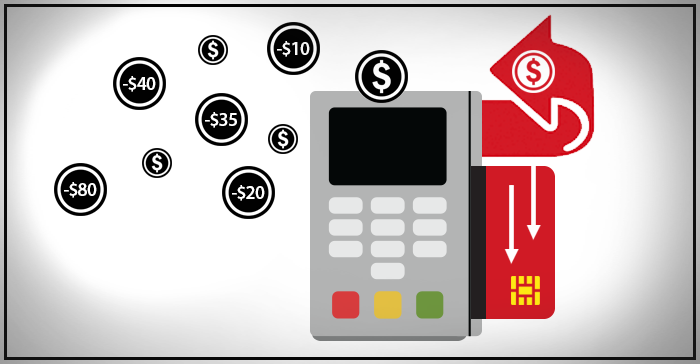 With EMV in full swing in the U.S., chargebacks have been on the rise – especially for restaurateurs. Following a successful co-hosted webinar with National Restaurant Association on the basics of chargeback management and best practices last month, we discovered a second installment was in high demand.
The webinar took a deeper dive into the rules of EMV and chargebacks and what you can do to avoid them. If you weren’t able to join us for the presentation, we’ve summarized the high points here to help you better understand chargebacks and the liability shift.
Why EMV, Why Now?
Protecting yourself against counterfeit fraud is one of the main benefits to implement EMV because it’s virtually impossible to recreate the chip. The October 1, 2015 shift has caused some serious headaches, but the ultimate goal is to fix the payment ecosystem by heightening card security. There is, however, a glitch—if your equipment isn’t EMV-compatible, then use of a fraudulent EMV card can go undetected.
Zebra’s New ZXP Series 7 Pro Service Bureau ID Card Printer
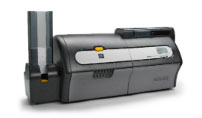 The ZXP Series 7 Pro provides higher volume card printing with all the great features and speed of the ZXP 7.  With a mechanical FIFO output hopper, the ZXP Series 7 Pro is capable of printing 250 plastic cards at one time and comes standard with a magnetic encoder.  Not only that, but each unit is shipped with a complementary license key for Zebra’s Virtual PrintWare Suite, making it even easier to manage multiple units from a single location.  And it’s open-class status means it is available to ALL resellers.  No restrictions, certifications, or partner levels are required.
Zebra’s New Ultra-Rugged 3600 Series Barcode Scanners
 Zebra has announced the release of their new 3600 Ultra-Rugged series of scanners. They are purpose-built to exceed industry standards for durability, scan performance and manageability in demanding industrial environments such as warehouses, distribution centers, manufacturing shop floors and do-it-yourself (DIY) retail stores.
1D and 2D versions of the 3600 series are available with corded and cordless options for fast, accurate performance in picking, packing, shipping, receiving, work in progress (WIP), inventory tracking, track and trace, cross docking and point of sale (POS) applications. Built to perform in extreme conditions, the ultra-rugged scanner series offers the industry’s highest drop, tumble and sealing specifications in its class and is the industry’s first IP67-rated scanner capable of enduring complete water immersion for up to 30 minutes.
Honeywell Acquires Movilizer, Leader in Simplifying Operations for Remote Connected Workers
 Honeywell has completed its acquisition of privately held Movilizer, which created one of the world’s first cloud platforms for field service applications. Movilizer is used by remote workers performing service or maintenance, sales and distribution, and warehousing activities away from the office. Terms of the deal were not disclosed.
Movilizer’s cloud software enables a distributed workforce to create, deploy and manage workflow solutions – whether at the point of sale, in the field, in a warehouse or distribution center. Customers can seamlessly collect, transmit and analyze data generated by their workers on their existing information technology (IT) systems, enabling them to harness the power of their workforce from anywhere to best serve the needs of their end customers.
Valuable Label Features that Solve Common Retail Problems
 Most people don’t realize how many choices there are when it comes to designing a label or tag. Even the simplest of features can be cost-effective and can make a big impact in improving the overall retail store environment from back-office to customer experience. This white paper focuses on several features that can reduce shrink and improve customer satisfaction.
Shrink Management
To cut back on stolen merchandise, retailers are often required to implement expensive solutions like EAS (Electronic Article Surveillance) systems and trained security. However, there are less expense ways to deter theft.
Direct Part Marking (DPM) Explained
 While most barcodes you come across are printed on a label or paper-packaging of a product, in the manufacturing world and work-in-process applications many parts or components need to be marked with a barcode directly. Direct Part Marking is a process that allows  users to mark a barcode directly on an item instead of printing the barcode on a label.
There are 3 main technologies available for DPM:  laser or chemical etching, dot peening  and ink jet printing. Each of these has specific  advantages  and disadvantages  in terms  of durability, cost and ease of reading.  The main advantages  of codes with  DPM technology are that  the code is permanently marked  on a surface and will  survive  for a long  time  (ideally  forever), regardless  of the  stress the part is passing  through during its’ life cycle. The main  reasons to choose codes with  DPM technology are:
- Items that need to pass through harsh testing processes  (chemicals  agents, thermal cycles, oil, moisture, etc.)
- Items that need to  be tracked  during  their  entire life cycle
- Very small items (difficult to label)
DPM technology was first  adopted  mainly  by the automotive and general mechanical industries. Currently, the popularity of codes using  DPM technology has spread into  different sectors  including electronics, chemicals  and healthcare  industries.
POS-X’s New ION TP5 All-in-One Point of Sale Terminal
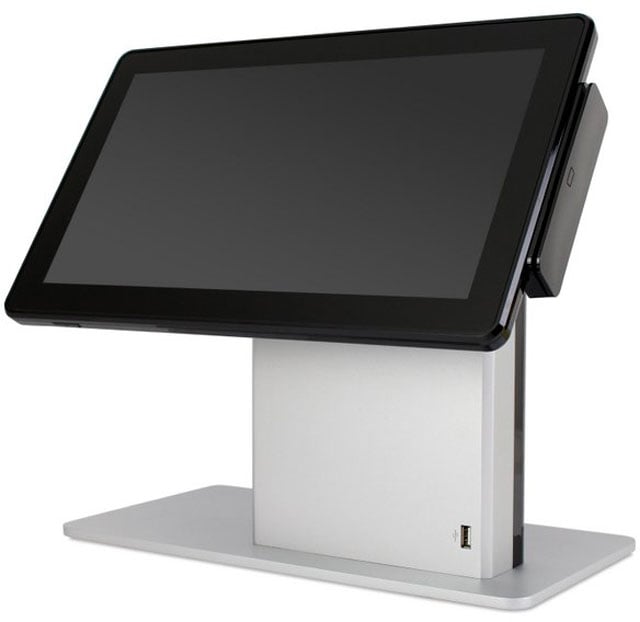 POS-X has announced the availability of their new ION TP5 all-in-one terminals.  Designed for businesses large and small, the ION TP5 leverages the latest in tablet technology and quality build materials to produce an ultra-compact and cost-effective point-of-sale terminal.
Available in two versions, the standard ION TP5 or the ION TP5 with Integrated Printer, the ION TP5 comes standard with a TruFlat 14″ widescreen LCD display, multi-touch projected capacitive (PCAP) touchscreen, Intel quad-core processor, and solid state storage. Additional accessories include an integrated MSR and rear customer display.
“The ION TP5’s design is a move away from yesterday’s traditionally bulky POS Terminals,†states Mark Dunlop, Vice President of Sales for POS-X. “Leveraging the latest in tablet and touch technology, the ION TP5 is both modern looking and compact, with a price point that rivals entry level competitors.â€
Perfect for all retail and hospitality POS applications, the ION TP5 supports Windows 8.1 and 10 and comes standard with POS-X’s industry leading free 3 year/2-day advance exchange warranty service.
Zebra’s TC8000 Provides Revolutionary Warehouse Productivity Gains
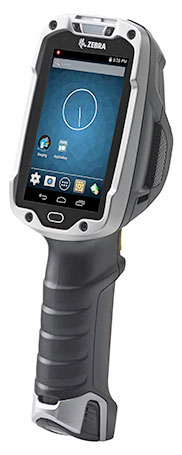 The standard for mobile computers has followed the same general form factor since their inception. Essentially following the original PDT format, mobile computers may have added things like pistol grips but the scanner axis has been perpendicular to the display. With every scan you are always in a sequence of tilt-to-read the screen and tilt-to-scan motion. Though it may not seem significant, every tilt takes time and fatigues a user’s wrist.
Zebra is the only manufacturer to properly address the issue of wasted motion and needless fatigue while researching the mechanics of warehouse workflow. The TC8000’s  unique design is the fruit of this detailed investigation into improving the worker experience and their efficiency.
The TC8000 minimizes motion with an innovative scan angle that eliminates the thousands of times your workers need to tilt their device to see the screen. With the TC8000 you can always scan and view the screen at the same time. It’s also an amazing 33 percent lighter than the traditional device to help minimize fatigue.
With a large touchscreen, the user experience is similar to a smartphone that everyone is familiar with which makes the TC8000 very easy to integrate into any environment.
You may ask how much difference these differences actually make? On average, the TC8000 improves productivity by 14% per worker versus the traditional form factors. And it’s the only device on the market that simplifies it all, how your workers physically use the device and interact with your warehouse application.
Key Features
- Superior ergonomics for superior productivity and worker comfort
- Rugged and ready for your warehouse
- Enterprise-class android kitkat
- Triple-shift battery power and unsurpassed battery management
- Capture multiple barcodes and entire forms with a single scan with SimulScan
- Advanced touchscreen technology for flexible data input
House of Fraser Takes Control of Price Management with Datalogic’s Skorpio X3
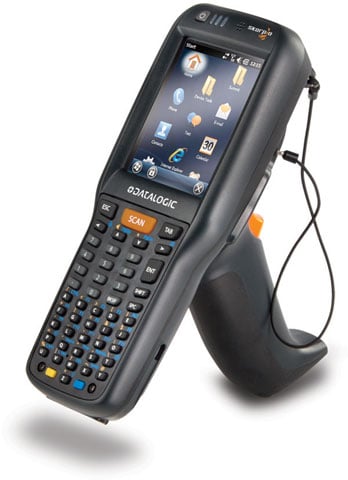 Datalogic has announced that premium United Kingdom department store, House of Fraser, is using Skorpio X3 mobile computers to improve the price management processes.
House of Fraser, owned by Nanjing Xinjiekou Department Store Co. Ltd., a leading chain of Chinese department stores, purchased 290 Skorpio X3 devices following an extensive pilot program run in its Glasgow and Bristol stores with Datalogic business partner Capgemini.
The primary function for the mobile computers is to aid and improve price management processes. Paired with a mobile label printer via the integrated Bluetooth communications on the Skorpio device, employees can price check items and then print accurate clearance labels on the shop floor, affixing them to items within seconds. “The ability to price check and print on the spot enables us to more accurately and efficiently prepare for sale periods and provides our customers with a clear and professional presentation of the item price that minimizes queries and reduces checkout times,â€Â - Fred Jefferiss, Commercial Finance Controller at the House of Fraser.