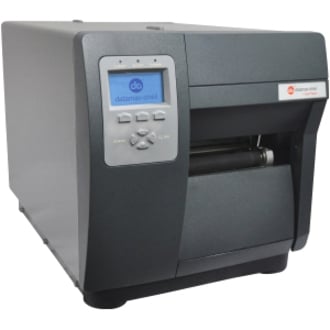
Datamax-O'Neil's I-Class revolutionized the barcode printer industry with its award winning modular design, field installable options and rugged reliability. For the past several years, resellers have named the I-Class the "best channel product" in some of the industry's largest third-party surveys. Now we've raised the bar even higher, with the redesigned I-Class Mark II.
Offering the fastest processor, largest memory and widest selection of communication ports available in a mid-range printer, the I-Class Mark II provides lower operating costs and flawless print quality. For applications as diverse as shipping and receiving, product identification, pharmacy labeling and asset tracking, the I-Class Mark II will maintain its reputation for providing outstanding for performance, reliability and value.
What are the key printing specifications of the Honeywell I16-00-4P000007?
The Honeywell I16-00-4P000007 is a thermal transfer barcode label printer capable of 600 dpi resolution, delivering high-quality barcode and label output for industrial applications. This desktop printer supports multiple connectivity options including parallel, serial, and USB interfaces, making it compatible with various warehouse management and inventory systems. We offer this model as part of our comprehensive Honeywell printer lineup for businesses requiring reliable label printing solutions.
What connectivity options does the Honeywell I16-00-4P000007 support?
The Honeywell I16-00-4P000007 supports three connectivity methods: parallel, serial, and USB connections, allowing flexible integration with legacy and modern warehouse systems. This multi-interface capability ensures compatibility with existing IT infrastructure and enables easy upgrades without requiring complete system overhauls. Contact us today to discuss which connectivity option best fits your operational setup.
Is the Honeywell I16-00-4P000007 suitable for high-volume label printing?
Yes, the Honeywell I16-00-4P000007 is designed as an industrial desktop printer capable of handling demanding barcode and label printing requirements in warehouse and logistics environments. Its 600 dpi thermal transfer technology ensures consistent print quality even during extended production runs. We recommend this model for organizations managing inventory at scale—visit barcodesinc.com or contact our team to discuss your volume requirements.
What types of labels and materials can the Honeywell I16-00-4P000007 print on?
As a thermal transfer printer, the Honeywell I16-00-4P000007 prints on a wide range of label materials including paper, polyester, and synthetic substrates, making it versatile for various warehouse labeling applications. The thermal transfer technology requires compatible ribbons and is ideal for applications requiring durable, long-lasting barcode labels resistant to fading and environmental exposure. Contact us today for specific material recommendations and ribbon compatibility information.
What is the difference between thermal transfer and direct thermal printing?
The Honeywell I16-00-4P000007 uses thermal transfer technology, which applies heat to a ribbon to transfer ink onto labels, resulting in more durable and longer-lasting prints compared to direct thermal methods. Thermal transfer printing is ideal for applications requiring label longevity and resistance to moisture, heat, and chemical exposure—common in industrial and logistics environments. We offer both thermal transfer and direct thermal options depending on your durability and cost requirements—visit barcodesinc.com to explore the right solution for your needs.
Does the Honeywell I16-00-4P000007 require special software or drivers?
The Honeywell I16-00-4P000007 integrates with standard printer drivers and is compatible with most warehouse management and inventory software systems through its parallel, serial, and USB interfaces. Installation manuals and technical documentation are available to ensure proper setup and configuration in your environment. Contact us today for driver support, installation guidance, and compatibility verification with your existing systems.