


- 2.40 GHz
- 5 GHz
- 6 GHz
- WPA
- WPA2
- WPA3-ENT
- WPA3
- WPA2-MPSK
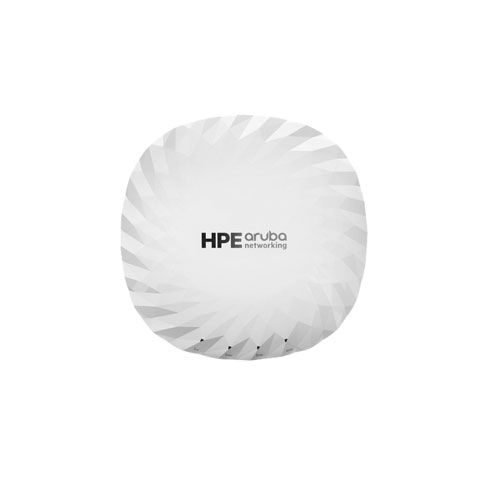
Enterprise-grade tri-radio Wi-Fi 7 AP delivering up to 9.3 Gbps tri-band throughput, expandable to 14.4 Gbps in dual-6 GHz mode. Dual 5 GbE Smart Rate uplinks with MACsec and PoE-PD offer redundancy and security. Patented UTB filtering prevents interference between 5 GHz and 6 GHz bands. Integrated Bluetooth 5.4 and Zigbee radios plus GNSS and barometric sensors support IoT and indoor mapping. Cloud-native AI management automates RF tuning and power-saving.
Key Features
Specifications
For enterprises looking for to deliver secure, high-performance Wi-Fi to users and IoT devices today and in the future, HPE Aruba Networking 730 Series Campus APs extend beyond the Wi-Fi 7 standard to maximize GHz capacity by up to 30%, connect 2X the IoT devices, strengthen security across wired and wireless, and enable highly accurate location-aware capabilities. Unique to HPE Aruba Networking, the 730 Series APs includes Ultra Tri-Band (UTB) filtering and dual 5 Gbps Ethernet ports to eliminate coverage gaps, provide greater resiliency, and deliver fast, secure connectivity. Intelligent automation, AI insights, and unified infrastructure management, provided by HPE Aruba Networking Wireless Operating System (AOS-10) and HPE Aruba Networking Central, help drive efficient IT operations.
More capacity and wider channels
The HPE Aruba Networking 730 Series Campus APs are designed to take advantage of the 6 GHz band via three dedicated radios, which translates into far greater speeds, wider channels for multi-gigabit traffic, and less interference. It delivers up to 9.3 Gbps maximum tri-band aggregate data rate, using three 2x2 MIMO radios (2.4 GHz, 5 GHz, and 6 GHz).
To further increase the wireless capacity, the 2.4 GHz radio can be reconfigured to deliver an optional dual-5 GHz or dual-6 GHz mode, which further increases the maximum aggregate data rate to 14.4 Gbps in dual 6 GHz mode.
Wi-Fi 7 standard
The new Wi-Fi 7 standard (802.11be) extends the capabilities of Wi-Fi 6E, including the use of the 6 GHz band. New capabilities include wide 320 MHz bandwidth channels, multi-link operation (MLO) for channel aggregation across different bands and failover, and 4096 QAM (4K QAM) for higher peak data rates.
Advantages of 6 GHz
Wi-Fi 7 takes advantage of up to 1200 MHz in the 6 GHz band for higher throughput and improved application performance. With up to three 320 MHz channels or seven 160 MHz channels, Wi-Fi 7 can better support low-latency, bandwidth hungry applications like high-definition video and artificial reality/virtual reality applications. Only Wi-Fi 6E or 7 capable devices can use the 6 GHz band so there is no interference or slowdowns due to legacy devices.
Device class support
HPE Aruba Networking AP-735 Campus APs with integrated antennas are part of the Low Power Indoor (LPI) device class. This fixed indoor-only class uses lower power levels and does not require an Automated Frequency Coordination service (AFC) to manage incumbent outdoor services which is required for standard class APs. The AP-734 connectorized models will typically operate as Standard Power access points but may also be allowed to operate as Low Power Indoor devices in some countries.
Less interference
HPE Aruba Networking 730 Series Campus APs include HPE Aruba Networking's patented Ultra Tri-band filtering, which enables enterprises to take advantage of the high end of 5 GHz with the lower end of 6 GHz without experiencing interference.Since there is only 50 MHz between 5 GHz and 6 GHz, without advanced filtering, enterprises would likely experience problems between the bands and would therefore be limited in the number of channels available. By applying advanced filtering capabilities, enterprises can fully utilize the available spectrum without creating coverage gaps or islands
The HPE Aruba S1G48A is a Wi-Fi 7 (802.11be) access point that delivers up to 9.3 Gbps aggregate tri-band throughput, expandable to 14.4 Gbps in dual-6 GHz mode. It supports Multi-Link Operation (MLO) and EHT320 channels for maximum performance across 2.4 GHz, 5 GHz, and 6 GHz bands with 2×2 spatial streams per band.
Yes, the S1G48A integrates Bluetooth 5.4 and Zigbee radios for seamless IoT device connectivity, plus GNSS and barometric sensors for precise indoor mapping and location services. This makes it ideal for enterprises deploying asset tracking and location-based applications alongside traditional Wi-Fi clients.
The S1G48A includes WPA3, Opportunistic Wireless Encryption (OWE), MACsec on its dual 5 GbE uplinks, and TPM 2.0 for hardware-based security. These features protect both wireless client traffic and wired backhaul connections, meeting enterprise security requirements.
The S1G48A supports up to 400 concurrent clients per radio, providing capacity for dense deployments in campuses, warehouses, and enterprise environments. With three radios (2.4 GHz, 5 GHz, and 6 GHz), this enables scalable client distribution across bands.
The S1G48A features dual 5 GbE Smart Rate PoE-PD ports with LACP support for redundancy and load balancing, and can be powered via DC 12V or PoE Class 3–5. The dual uplinks with MACsec encryption ensure secure, fault-tolerant network connectivity.
The S1G48A is designed for indoor campus deployments with an operating temperature range of 0–50 °C and compact dimensions of 240×240×56 mm weighing 1.44 kg. For outdoor or extreme temperature applications, consult our team at barcodesinc.com to explore alternative HPE Aruba access point models.