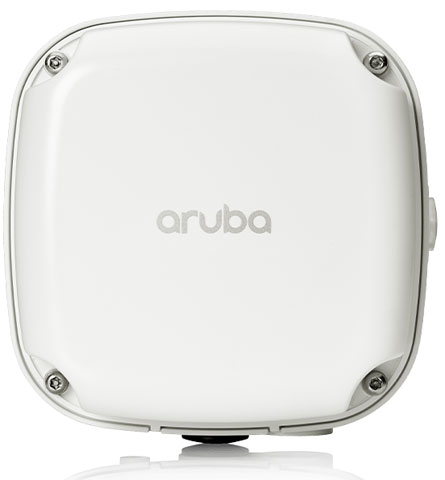
HPE Aruba 560 Series Wireless Access Points Model Overview
Ideal for campuses, venues and industrial sites, the 560 Series AP offers enterprise-class Wi-Fi 6 in a rugged outdoor form factor. Two 2×2:2 radios deliver up to 1.49 Gbps aggregate throughput with OFDMA and MU-MIMO for efficient multi-user access. Its IP55-rated enclosure resists dust, moisture and extreme temperatures, while integrated Bluetooth 5 and Zigbee radios support IoT deployments. Automated provisioning and centralized management reduce operational complexity, and policy enforcement firewalls keep guest and operational traffic secure.
Key Features
1.49 Gbps aggregate Wi-Fi 6 performance
OFDMA and MU-MIMO for optimized capacity
IP55-rated, –40 °C to +65 °C; weather and wind resistant
Bluetooth 5 & Zigbee for seamless IoT integration
Zero-touch provisioning and cloud management
Dynamic segmentation and built-in firewall
Specifications
5 GHz HE80: 1.2 Gbps; 2.4 GHz HE40: 574 Mbps
Model options: internal omni or integrated directional antenna
1×1 GbE RJ-45 port for uplink
Power options: 802.3af/at PoE or 12 V DC
Power consumption: 15.6 W max; 4.2 W idle
Size: 110 × 165 × 165 mm; Weight: 1.09 kg
HPE Aruba R4W55A Wireless Access Points Overview
Entry-level Wi-Fi 6 (802.11ax) for outdoor and warehouse environments
Weatherproof and temperature hardened, Aruba 560 series access points deliver cost-effective Wi-Fi 6 wireless connectivity in outdoor and environmentally challenging locations.
Purpose-built to survive in the harshest outdoor environments, 560 series can withstand exposure to extreme high and low temperatures, persistent moisture and precipitation, and are fully sealed to keep out airborne contaminants. All electrical interfaces include industrial strength surge protection.
Aruba Wi-Fi 6 access points provide high-performance connectivity for any organization experiencing growing numbers of IoT and mobility requirements. With maximum aggregate on air data rate of 1.49 Gbps (HE80/HE20), they deliver the speed and reliability needed for most environments.
The Aruba advanced ClientMatch technology and an integrated Bluetooth beacon can help enable Aruba location services.
What Wi-Fi 6 performance can I expect from the HPE Aruba 560 Series AP?
The HPE Aruba 560 Series delivers up to 1.49 Gbps aggregate throughput with dual 2×2:2 radios—1.2 Gbps on the 5 GHz HE80 band and 574 Mbps on the 2.4 GHz HE40 band. OFDMA and MU-MIMO technologies optimize capacity for efficient multi-user access, making it ideal for high-density deployments in campuses and venues.
Is the HPE Aruba 560 Series suitable for outdoor and harsh environments?
Yes, the 560 Series is specifically designed for outdoor deployment with an IP55-rated enclosure that resists dust and moisture. It operates reliably in extreme temperatures ranging from –40 °C to +65 °C and is wind-resistant, making it perfect for industrial sites, stadiums, and outdoor campus areas.
Does this access point support IoT device connectivity?
Absolutely. The HPE Aruba 560 Series includes integrated Bluetooth 5 and Zigbee radios for seamless IoT integration, allowing you to connect and manage IoT devices alongside your primary Wi-Fi 6 network without additional hardware.
What power options are available for the HPE Aruba 560 Series?
We offer two power delivery options: standard 802.3af/at PoE (Power over Ethernet) or 12 V DC direct power. Maximum power consumption is just 15.6 W, with idle consumption at 4.2 W, making it energy-efficient for large-scale deployments.
How does centralized management simplify deployment of these access points?
The 560 Series features zero-touch provisioning and cloud-based centralized management that dramatically reduces operational complexity. Built-in dynamic segmentation and firewall capabilities enable policy enforcement for guest and operational traffic without manual configuration on each device.
What connectivity and antenna options are available?
The access point includes a 1×1 GbE RJ-45 port for uplink connectivity and is available in two antenna configurations: internal omnidirectional or integrated directional antenna. This flexibility allows you to optimize coverage based on your specific deployment topology.
The HPE Aruba R4W55A Wireless Access Points is also known as
HPE-R4W55A