

- 2.40 GHz
- 5 GHz
- WPA
- WPA2
- WPA3
- WPA-ENT
- WPA2-ENT
- WPA3-ENT
- WPA3-SAE
- WPA2-MPSK
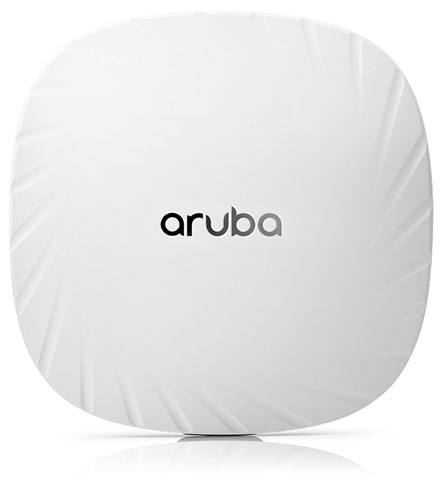
Designed for cost-sensitive deployments that demand enterprise-class features, this campus AP supports dual 2×2:2 radios on 5 GHz and 2.4 GHz bands to deliver up to 1.77 Gbps total throughput. Its small form factor and versatile ceiling or wall-mount options fit classrooms, branch offices and retail stores. Built-in OFDMA and MU-MIMO reduce airtime contention for dozens of connected devices, while automated RF tools—ClientMatch and AirMatch—optimize performance and roaming without manual tuning. The two Smart Rate 1 GbE ports provide PoE in or out for network or downstream devices, and the USB 2.0 host port supports local edge services. Security is enforced with WPA3, Enhanced Open and MACsec.
Key Features
Specifications
Cost-effective Wi-Fi 6 (802.11ax) for mediumdensity indoor environments
These affordable Wi-Fi 6 access points provide high-performance connectivity for any organization experiencing growing numbers of mobile, IoT and mobility requirements. With a maximum real-world aggregate data rate of 1.49 Gbps (HE80/HE20), they deliver the speed and reliability needed for venues and workplaces such as schools, midsize offices and retailers.
INCREDIBLE EFFICIENCY
The 500 Series APs are also designed to optimize user experience by maximizing Wi-Fi efficiency and dramatically reducing airtime contention between clients.
Features include Orthogonal frequency-division multiple access (OFDMA), and cellular optimization. With up to 2 spatial streams (2SS) and 80MHz channel bandwidth (HE80), the 500 Series provides groundbreaking wireless capabilities for budget-conscious deployments.
Read the Multi-User 802.11ax white paper for further information.
Advantages of OFDMA
This capability allows Aruba's APs to handle multiple Wi-Fi 6 capable clients on each channel simultaneously, regardless of device or traffic type. Channel utilization is optimized by handling each transaction via smaller sub-carriers or resource units (RUs), which means that clients are sharing a channel and not competing for airtime and bandwidth.
Aruba Air Slice™ for Extended Application Assurance
Initially, APs in controller-less mode (Instant) can provide SLA-grade performance by allocating radio resources, such as time, frequency, and spatial streams, to specific traffic types. By combining Aruba's Policy Enforcement Firewall (PEF) and Layer 7 deep packet inspection (DPI) to identify user roles and applications, the APs will dynamically allocate the bandwidth needed. Non-Wi-Fi 6 clients can also benefit.
Air Slice™ for APs uses Aruba Central for management. Controller-based APs will be supported in a future software release.
Wi-Fi 6 aware client optimization
Aruba's patented AI-powered ClientMatch technology eliminates sticky client issues by placing Wi-Fi 6 capable devices on the best available AP. Session metrics are used to steer mobile devices to the best AP based on available bandwidth, types of applications being used and traffic type - even as users roam.
Aruba Advanced Cellular Coexistence (ACC)
This feature uses built-in filtering to automatically minimize the impact of interference from cellular networks, distributed antenna systems (DAS), and commercial small cell or femtocell equipment.
Intelligent Power Monitoring (IPM)
Aruba APs continuously monitor and report hardware energy consumption. They can also be configured to enable or disable capabilities based on available PoE power - ideal when wired switches have exhausted their power budget.
Green AP energy efficiency
Aruba Wi-Fi 6 APs utilize analytics from NetInsight to automatically transition in and out of a sleep mode based on client density. Learn more in the Green AP At-A-Glance.